

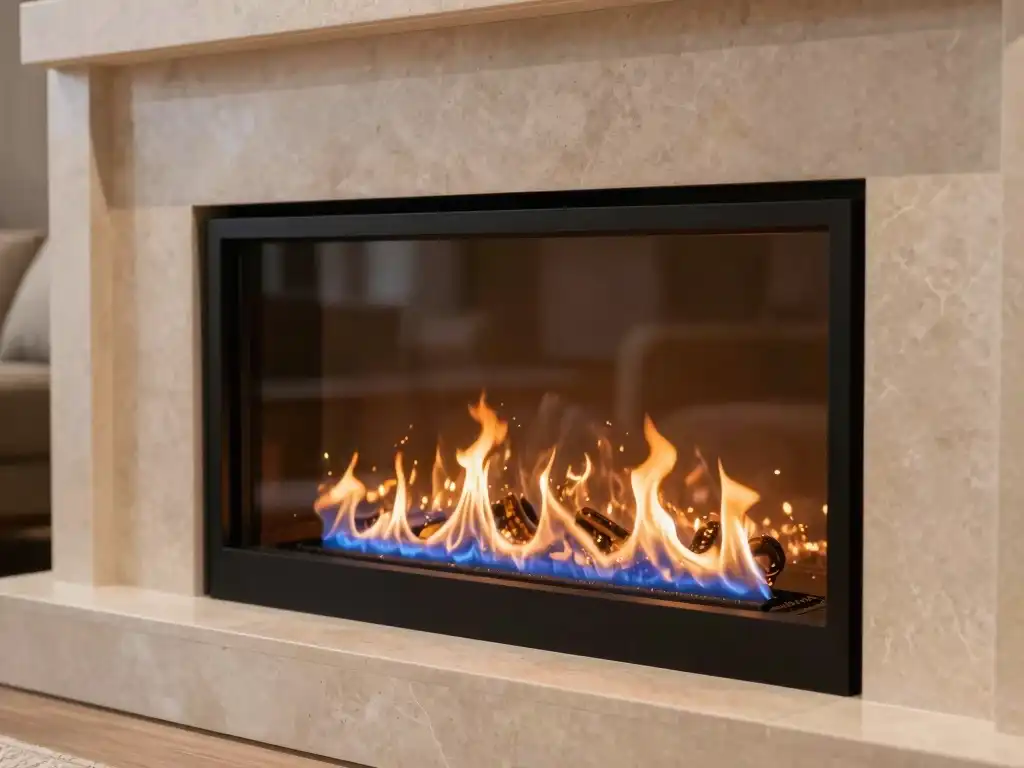
Brand New Fireplace Installation for Kansas City Homes – Start Here
Blueprint for a new fireplace in Kansas City starts with one honest number: a professionally installed unit typically runs $5,500-$14,000 all-in, and what swings that range up or down comes down to three things – what fuel type you choose, how complicated the venting path is, and how much wall, framing, and finish work your house actually needs. That’s the real framework, and this article will walk you through exactly how a pro starts – with a room sketch, not a product catalog – then layers in venting, utilities, and finish decisions so you can see where every dollar is going before anyone picks up a hammer.
What a Brand New Fireplace Really Costs in Kansas City
Here’s the unglamorous truth: your local building code and the manufacturer’s manual are more important than any Pinterest photo. The three buckets that drive every new fireplace installation cost in Kansas City are the appliance itself, the venting path, and the surrounding construction and finish work. The appliance is usually the easiest to price. It’s the other two that tend to surprise people. Venting complexity alone can swing a job by $2,000-$4,000, and if your house needs serious framing, a new gas line, or an upgraded circuit, that number moves again – fast.
Local code and the manufacturer’s installation manual are the two documents that actually decide what’s allowed, what materials are required, and how expensive the whole project can get – way more than any showroom visit or online inspiration board. My whole goal at ChimneyKS is “no-surprises” pricing built directly from those two rulebooks, not from ballpark guesses and hopeful assumptions. Here’s how the scenarios break down for a typical KC home in 2026:
Start With the Room, Not the Firebox: Layout, Seating, and Traffic
On my notepad, I always start with a box for the room, not the fireplace. I sketch a top-down view – where the couch goes, where people walk in from the kitchen, where the TV sits, and yes, where the dog bed ends up. Those details drive everything: where the fireplace lands on the wall, how high the firebox opens, how wide the surround can be. Most people come to me with a product already picked out. I get it – the glossy photos are compelling. But if I draw your room to scale and your dream unit eats three feet of your main traffic path or puts heat right behind the sectional, we’ve got a problem that no amount of pretty stone veneer is going to solve. The room has to work for a random Tuesday night in February, not just a staged photo shoot.
When I walk into your living room, the first question I’m really asking myself is, “Where can heat and exhaust safely go in this house?” – and the answer looks different depending on where you live in the metro. Brookside bungalows have tight original framing, low rooflines, and almost no wall depth to spare; running a new chase means careful coordination with headers and joists. Overland Park open-plan family rooms often have great exterior walls but long gas-line runs from the meter. Liberty basements can be dream fireplace rooms or frustrating dead ends depending on whether you’ve got a walkout wall or a fully buried foundation. Each of those layouts changes what’s realistic for new fireplace placement before we ever talk about a specific unit.
Fuel and Venting Choices: Gas, Wood, or Electric in a KC Home
Let me be blunt: the fastest way to wreck a new fireplace project is to pick the unit before you understand the venting. I learned this the hard way watching other people’s projects fall apart – and once, very early on a January morning, I walked into a Brookside bungalow where a couple had bought a beautiful linear gas unit online, convinced it would “just slide in” to their old wood-burning firebox. It was 9 degrees, their space heater kept tripping the breaker, and they were huddled in coats in their own living room. That unit wouldn’t fit the existing chase even close to spec. Worse, the venting plan they’d sketched out would have dumped flue gases directly into the attic. We ended up redesigning the entire installation – framing a new chase and running a proper direct-vent line through the roof. They got heat two weeks later, but and this matters, we dodged a genuinely serious carbon monoxide situation. The pretty unit was never the problem. The vent path was.
Each fuel type brings its own set of real-world constraints. Wood-burning fireplaces need a full chimney system – class-A rated, with proper clearances from every combustible surface, and make-up air provisions if your house is well-sealed. Gas units are flexible and controllable, but they need a safe vent route either through the sidewall or up through the roof, a properly sized gas line, and they have to be installed strictly to the manufacturer’s specs, not approximately. Electric is the easiest from a structural standpoint, but “easy” doesn’t mean zero planning – higher-output units need a dedicated circuit, the recess needs non-combustible materials, and if you’re combining it with a TV above, heat shielding is not optional.
Think of your fireplace like a small appliance that’s permanently welded to your house’s skeleton – every support, every pipe, every wire around it has to make sense structurally and mechanically, not just visually. The vent pipe becomes part of the framing system. The gas line follows your house’s plumbing logic. The wiring ties into your panel. That’s why fuel and unit selection is a structural decision first and a décor decision second. The sketch on my notepad doesn’t lie – if the vent path doesn’t fit cleanly in the drawing, it’s not going to fit cleanly in the house.
If we can’t draw a safe, code-legal vent path on paper, we have no business talking about stone samples yet.
What a Proper Fireplace Installation Process Looks Like
One July afternoon when it was pushing 100 degrees, I was doing a pre-installation check on an Overland Park new build. The GC wanted to save time by having his trim crew set a zero-clearance wood unit they’d just unboxed. I walked in and found the unit sitting directly against OSB with no proper clearances maintained, and a plan to run the gas line through the firebox cavity. I had to shut the entire thing down – pull the unit back, reframe that wall from scratch, and sit at the homeowner’s kitchen island with the manufacturer’s installation manual open between us, going through it line by line: here’s what they require, here’s what was done, here’s the gap. That job eventually passed inspection on the first try and turned into one of my better new installs. But it started as a textbook example of what happens when speed overrules process. No installer who’s ever read a manufacturer’s manual carefully would have set that box that way.
When I walk into your living room, the first question I’m really asking myself is, “Where can heat and exhaust safely go in this house?” – and from that question, a consistent process follows every single time. And here’s an insider note worth taking seriously: reading the manufacturer’s manual together at the kitchen table before any framing starts prevents most last-minute change orders and inspection failures. Not after the chase is framed. Before. The manual is the rulebook, and every other decision – framing dimensions, clearance distances, vent termination height, hearth depth – flows from what’s printed in it.
Avoiding Common New Fireplace Mistakes in KC Homes
There was a late fall evening in Liberty where I got called out because a brand-new electric fireplace the homeowner had picked up from a big-box store kept tripping the breaker and overheating the wall behind it. He’d cut a hole between two studs, stuffed the unit in, and plugged it into an old outlet that already fed half the living room and a window A/C. I was standing there at 8 p.m., rain coming sideways, explaining that the wall behind that unit was basically turning into a toaster – and that the fix wasn’t a bigger breaker. We needed a dedicated circuit, a properly sized recess with non-combustible lining, and honestly a different unit entirely. We scrapped that box-store special, installed a hardwired in-wall electric unit that actually met code, and suddenly he had a fireplace that worked. But that call-back job is the same kind of mistake I see in some form almost every month around the metro.
A new fireplace becomes part of your home’s structure and safety system the moment framing starts – it’s not a piece of furniture you can return or rearrange. Getting the layout, venting path, and utilities right on paper is genuinely half the job. Call ChimneyKS and let Michael pull up a chair at your kitchen table, sketch your room to scale, and put together a clear, line-item plan for a new fireplace installation in Kansas City that actually fits your home, your budget, and the two documents that matter most: local code and the manufacturer’s manual.