

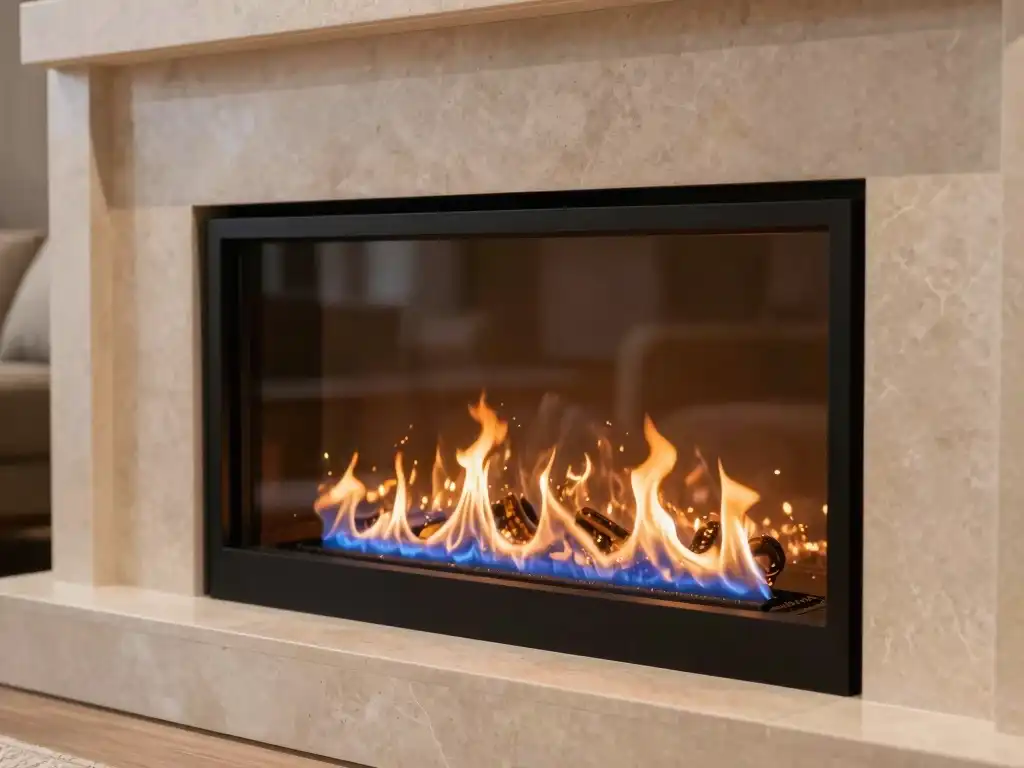
Trusted Fireplace Installer Serving the Entire Kansas City Metro Area
Strangely, the most trustworthy fireplace installer in Kansas City is often the one who talks you out of the wrong unit before the conversation ever reaches brand names, trim colors, or flame patterns. This guide walks through how safe, well-performing fireplace installation actually gets decided in real Kansas City homes – not in a showroom, and not from a brochure.
Why the smartest install starts with saying no
Strangely, the first sign that an installer knows what they’re doing is when they slow down the product conversation. I’ve been doing this seventeen years, and some of the most valuable things I’ve said on a first visit were “that unit’s wrong for this room” or “that vent path won’t work the way you’re imagining.” A homeowner comes in thinking about flame appearance and BTU ratings, and a good installer is already running a different checklist in their head – one that starts with what the house will and won’t allow. Appearance comes last. The hidden system decides everything before that.
I think of a fireplace like stage rigging – if the support and path are wrong, the show doesn’t matter. What you see in the living room is the set. The performance, and honestly the safety, come from what’s behind the wall: the vent route, the framing clearances, the chase design, and whether combustion air can actually reach and leave the unit the way the manufacturer intended. Product brochures are the least useful part of that conversation until venting, clearance, and structure are understood. Pulling back the curtain on that hidden system is what the first visit is really for.
| Myth | What a Trusted Installer Actually Checks |
|---|---|
| Bigger units always heat better | Room volume, ceiling height, and envelope tightness determine the right BTU range – an oversized unit short-cycles, drafts poorly, and often leaves a room uncomfortably hot near the fireplace and cold everywhere else |
| If the fireplace is new, venting must be correct | Termination placement, wind patterns, and vent routing can all defeat a brand-new unit – age of equipment doesn’t tell you whether the air path is right |
| A clean wall finish means framing behind it is fine | Finished drywall hides everything. Charred framing, improper clearances, and blocked chase spaces are regularly found behind walls that looked completely normal on the surface |
| Any installer can swap wood to gas quickly | Wood-to-gas conversions require vent liner sizing, gas line confirmation, clearance review, and sometimes surround work – rushing any of those steps creates real hazards |
| Brand choice matters more than placement | Where the fireplace sits, how it vents, and how it fits the room’s air dynamics matter far more than which manufacturer’s nameplate is on the front – a well-placed mid-tier unit beats a premium unit in the wrong spot |
Inside the house checks that decide whether a fireplace will behave
Questions to answer before measuring the opening
Seventeen years in, I can usually tell from the first five minutes whether a room is going to cooperate. Ceiling height, insulation tightness, chase location, where exterior walls land – I’m reading all of that before I’ve opened a single product catalog. Kansas City’s housing mix makes this especially important. Older Brookside and Waldo homes were built in eras when framing was done without modern clearance standards, and you’ll find surprises behind walls that have been refinished two or three times since. On the other end, newer bump-out additions and tightly sealed construction create airflow dynamics that can push exhaust right back toward the intake if the termination isn’t placed and angled correctly. The house tells you what it will and won’t accept. You just have to listen to it first.
Here’s the part homeowners don’t get told enough – wind matters. One sleeting Tuesday around 7:10 in the morning, I was in Brookside looking at a brand-new gas fireplace that had already tripped the homeowner’s carbon monoxide alarm twice. The unit itself was fine. What I found was a termination placed where wind wrapped around a bump-out and shoved exhaust right back toward the intake. We stood there in freezing drizzle while I showed them, with my notepad and a pencil, how the air was looping like a bad stage draft. The fix wasn’t a new fireplace. It was a repositioned termination and a deflector. But nobody had thought to map the air path before the original install, and that’s what turned a working unit into a CO hazard.
Blunt truth: a pretty fireplace can still be a bad installation. Once the hidden conditions are understood, the practical checklist gets straightforward – fuel type available, room volume and heat load, gas line or liner path, exterior wall or rooftop vent options, and every code-required clearance from firebox to framing. None of that is glamorous. But skipping any of it is how you end up with a fireplace that smokes on cold mornings, trips alarms on windy days, or hides damage that a future owner will eventually pay to fix.
-
1
Confirm what fuel sources are currently available – natural gas line, propane, or wood only -
2
Know whether this is a brand-new installation or a conversion/replacement of an existing unit -
3
Measure the approximate room dimensions and note ceiling height – this directly affects sizing -
4
Identify whether there’s a practical exterior wall or rooftop vent path from the planned fireplace location -
5
Check HOA rules or neighborhood restrictions that might affect venting, exterior cap appearance, or fuel type -
6
Pull together photos of the current opening, chase access, and any visible framing or liner – they save time at the estimate -
7
Note any history of smoke backing into the room, unusual odors, or alarm events – those symptoms almost always point to the hidden system, not the visible unit
A finished surface doesn’t prove safe construction behind it. During installation or conversion work, watch for these conditions:
- Charred framing – scorching or blackening on wood framing near the firebox, often hidden behind drywall from a prior remodel
- Inadequate clearances – combustible framing too close to the firebox or flue, often the result of someone building around rather than to code
- Blocked chase space – debris, insulation, or past materials partially blocking the vent path in ways that aren’t visible from the opening
- Poor termination placement – caps located where roof geometry or wall bump-outs create adverse wind pressure and exhaust recirculation
- Assumed safety from remodels – a clean finish coat installed over a previous problem doesn’t fix it; it just hides it until the next installation peels back the wall
Calm but firm: finished surfaces do not prove safe construction.
A quick way to sort your best fireplace path
What are you actually trying to fix – heat output, appearance, convenience, or a setup that’s already failing you? The answer changes everything about where the conversation should go. Use this decision path to get oriented before the first on-site visit.
Requires on-site sizing and clearance check
Requires on-site sizing and clearance check
Requires on-site sizing and clearance check
Requires on-site sizing and clearance check
Requires on-site sizing and clearance check
If the air path is wrong, the fireplace is just expensive scenery.
Comparing real installation routes across the metro
How each option changes budget, timeline, and wall work
A retired couple near Waldo called me after sunset in December because every installer they’d spoken to kept pushing the biggest fireplace in the brochure. Their room was modest – low ceiling, tight envelope, and already warm enough that they were cracking windows in January. I sat at their dining table with decaf coffee and walked through why oversized units behave badly in real houses: they short-cycle, they create uneven heat, and in a tight room with low ceilings they can overpower the space so fast the thermostat cuts them off before they ever reach steady draft. We ended up selecting a smaller insert, and the husband laughed because I was the first person who’d talked them out of spending more. That’s not a sales strategy – it’s just what happens when you size for the room instead of the showroom photo.
Here’s the insider thing nobody in the brochure business wants to say: installers who size by opening width alone instead of room volume, ceiling height, and envelope tightness are guessing. The right-sized unit for the actual room will draft better, cycle less, produce more consistent heat, and look more proportional on the wall than a unit that technically fits the opening but overwhelms the space. And honestly, it usually costs less too. The practical check – actual cubic footage, how tight the windows are, what the room connects to – is what separates a good recommendation from a high-ticket one.
| Scenario | Best Fit | Typical Wall / Vent Work | Estimated Timeframe | General Price Range |
|---|---|---|---|---|
| New direct-vent gas fireplace on exterior wall | No existing opening; exterior wall accessible | Framing chase, horizontal vent penetration, surround and finishing | 1-3 days depending on wall conditions | $3,500-$7,500+ (varies after inspection) |
| Gas insert into existing masonry opening | Functioning masonry fireplace with usable flue | Liner installation, surround trim, gas line connection | 1-2 days | $2,800-$6,000+ (varies after inspection) |
| Wood-to-gas conversion with surround work | Homeowner wants convenience without full rebuild | Liner sizing, gas line run, possible framing adjustment, new surround | 1-3 days; longer if hidden conditions are found | $3,000-$6,500+ (varies after inspection) |
| Venting correction for poorly performing newer unit | Alarm events, smoke backing in, poor draft on an existing install | Termination relocation, deflector addition, or liner correction | Half-day to full day | $500-$2,500+ (varies after inspection) |
| Rebuild after hidden framing or clearance issues are discovered | Charred framing, unsafe clearances uncovered mid-install | Structural repair, clearance correction, full framing and liner redo | 2-5 days; scope defined after damage assessment | $2,000-$8,000+ (highly variable; inspection-dependent) |
All ranges are general estimates. Final pricing is determined on-site based on local conditions, material costs, and scope discovered during assessment.
What trust looks like once demolition starts
How a careful installer handles surprises without sugarcoating them
I remember a Saturday in late October, just before a Chiefs game, when a family in Overland Park wanted their old wood-burning opening converted fast because relatives were coming over that night. Simple enough on paper. When I pulled the surround, I found charred framing hidden behind a neat-looking wall finish from an earlier remodel – scorching that nobody had dealt with, just drywalled over and forgotten. That job turned from a “simple install” into a safety conversation in about three minutes. The family wasn’t happy about it. And I’d rather ruin a football schedule than pretend hidden damage doesn’t matter, because the next person to find it might find it with a fire, not a pry bar. A trustworthy installer stops the job, explains what’s in the wall, and gives the homeowner an honest revised scope. That’s the whole job.
Trust in this trade isn’t abstract – it’s concrete actions. It’s documenting hidden conditions with photos before anything gets closed back up. It’s revising the written scope clearly when the job changes, not verbally at the end while you’re loading the truck. It’s explaining code-required changes in plain language without making the homeowner feel like they’re being upsold. And sometimes it means being willing to say the planned shortcut is unsafe and walking away from the job if the answer is still no. The backstage rigging isn’t glamorous, but it’s what keeps the show from burning down. ChimneyKS operates with that standard on every install across the Kansas City metro.
Questions worth asking before you hire
Full review of the room, chase, existing opening if present, vent path options, clearances, and any visible conditions behind trim or access panels
BTU range matched to actual room volume and envelope; vent routing confirmed on paper before product is selected
Clear line items covering unit, liner or vent components, framing, surround, and any anticipated structural work – no verbal-only pricing
Careful removal of existing surround, firebox, or wall section – documented as hidden conditions are revealed, not after the wall closes
All structural, clearance, and liner work completed to code before the unit is set and connected – sequence matters here
Unit tested for draft, combustion, and ignition; clearances confirmed; homeowner shown controls, maintenance basics, and what to watch for going forward
Explains venting and clearances in plain language – not just “it’ll be fine,” but actually shows you the air path and why placement matters
Documents hidden damage before proceeding – photos, written notes, and a clear explanation before the wall closes back up
Provides written scope updates when conditions change – not verbal add-ons at the end of the day when you’re too tired to push back
Serves the Kansas City metro with installation plus safety-minded evaluation – the goal is a fireplace that performs correctly, not one that’s simply finished and invoiced
If you’re ready for an honest fireplace installation evaluation in Kansas City – one that starts with venting, clearances, and structure before it ever gets to brand names or finishes – call ChimneyKS and schedule your on-site assessment. We’ll tell you what the house will actually support, and we’ll tell you straight.