

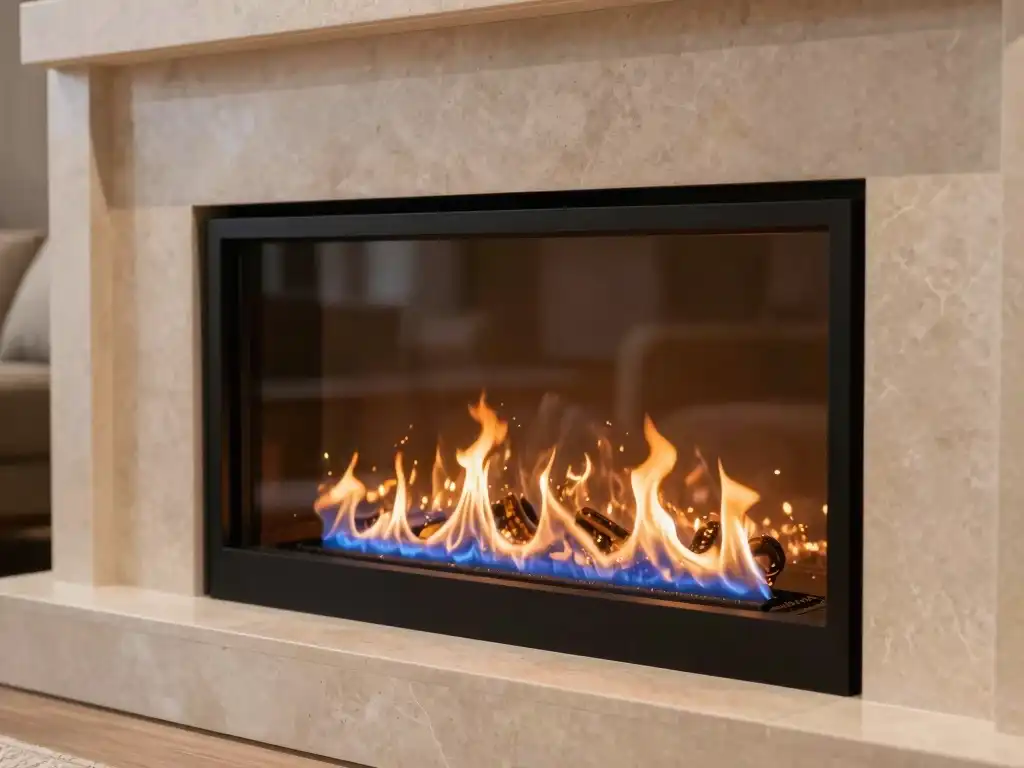
Fireplace Surround Remodel – Updating the Frame That Defines Your KC Fireplace
Quiet rooms tell on a bad surround faster than busy ones. Many Kansas City homeowners spend months assuming they have a chimney problem or a firebox issue when what they actually have is a framing problem-the opening works perfectly, the draft is fine, but the proportions around it are off, and the eye knows it even when the homeowner can’t name why. A fireplace surround remodel in Kansas City is rarely about swapping one finish for another. It’s about correcting what the eye reads from the hearth line up to the mantel shelf, and getting that frame cut right for the room it’s sitting in.
Why Your Fireplace Can Work Fine and Still Look Wrong
Quiet rooms tell on a bad surround faster than busy ones. A lot of people call assuming they have a chimney problem or a firebox problem, and I get it-those feel like structural explanations for something that feels structurally wrong. But in Kansas City living rooms, the real complaint is usually visual imbalance. And my honest opinion, stated plainly: if the frame around the fire looks accidental, the room never fully settles. It doesn’t matter how good the furniture is or how carefully the paint color was chosen. The fireplace is the anchor of the wall, and if it’s wearing the wrong jacket-cut too boxy, pinched too tight at the opening, or just oddly proportioned from hearth to mantel-the room reads unresolved every single time someone walks in.
What the surround actually controls is more specific than most people realize. It governs the visible width of the face around the opening, the height relationship between the firebox and the ceiling line, the reveal-meaning how much of the firebox edge the eye sees before hitting the surround material-and the thickness and weight of whatever material is doing the framing. The transition from hearth to mantel is one continuous visual line, and every element of the surround either supports that line or argues with it. When it argues, the room loses.
Reading Proportion Before Picking Tile or Stone
What I Measure First
Tape measure in hand, I’m not just checking size-I’m checking what your eye is being told. The specific numbers matter less than the relationships between them: opening width versus total surround face width, how high the surround runs relative to the ceiling line, how far the mantel projects, how much the hearth steps out from the wall, and how thick the proposed material will read from the middle of the room. Those last two points matter more than people expect. A material that looks clean in a showroom can read as heavy and loud from ten feet away in a low-ceilinged room. I’ve seen this play out differently in older Brookside homes versus Waldo bungalows versus Prairie Village ranch layouts. Brookside rooms tend to have stronger vertical architecture that tolerates a bolder mantel line. Waldo homes often run shallower on the firebox face and need slimmer material to preserve the reveal. Ranch houses in Prairie Village typically have lower ceilings and wider wall spans, which means the surround needs to work horizontally without ballooning the mass.
I remember one sleeting February morning in Brookside, around 7:15, standing in a living room with plastic still over the sofa while a homeowner told me she hated her fireplace but couldn’t explain why. The firebox was fine, the chimney was fine, but the surround had these skinny beige tiles and an oversized oak mantel that made the whole wall look like it was shrugging. I held my tape measure against the opening, stepped back twice, and told her, “Your fireplace isn’t broken-it’s wearing the wrong jacket.” We reworked the surround proportions, adjusted the mantel scale, and once the frame was cut right for the opening and the room, the whole space settled down. She hadn’t changed a single piece of furniture. The fix was entirely about proportion.
Materials come second to fit, every time. Stone, tile, brick, smooth plaster-any of them can work if they’re correctly tailored to the opening size and the room’s own scale. The wrong approach is picking a material you love in a photo and then working backward to make it fit. That’s how you end up with a beautiful tile that turns the fireplace into a visual argument. Pick the proportions, confirm the fit, then choose the material that best serves what you’ve already decided the surround needs to do.
How the Room Changes the Right Surround
Same Fireplace Opening, Different Visual Answer
1950s Ranch Living Room ▾
Lower ceilings and wider wall spans mean the surround has to stay controlled in height. Slimmer mantel profiles work better here-anything with significant overhang starts to visually press down on the room. Stone veneer, if used, should be kept thin and flat; heavy stacked stone reads as a wall bump rather than a frame. Horizontal tile orientation often makes the most sense in these rooms, reinforcing the natural width of the layout without competing with the ceiling line.
Older Brookside or Midtown Home ▾
These rooms tend to have more ceiling height and stronger architectural presence already built in. The surround can carry more vertical emphasis without fighting the room. A restrained stone thickness still applies-you don’t want the material reading heavier than the existing millwork. Tile in a vertical stack or a taller mantel line can reinforce the room’s own proportions rather than disrupting them. The challenge here is matching the surround’s visual weight to the room’s existing trim character without either under-delivering or overwhelming it.
Open-Concept Suburban Family Room ▾
Open floor plans make the fireplace visible from multiple angles and often from a greater distance, which means proportion errors read harder and wider. The surround needs enough visual mass to anchor a larger wall but not so much that it competes with the sightlines from the kitchen or dining area. Cleaner, more restrained profiles usually perform better here than highly textured or multi-material designs. The mantel matters more in these rooms because it’s frequently used as a visual shelf in a space that lacks interior walls to organize the room’s zones.
Mistakes That Make a Remodel Feel Smaller, Heavier, or Colder
Here’s my blunt opinion: if the frame around the fire looks accidental, the whole room does. I had a Saturday job in Waldo where a customer had tried to update the surround himself after watching three online videos and buying stone veneer that was way too chunky for the shallow firebox face. By noon it was already obvious the corners didn’t die in cleanly, the reveal around the opening had nearly disappeared, and the new surround made the fireplace look smaller instead of stronger. He was a good sport about it-honestly, he’d put real work in-but it was a clear reminder that surround remodels are spatial decisions as much as installation ones. The problems people blamed on color were actually caused by depth, edge treatment, and proportion. The stone wasn’t the wrong shade. It was the wrong thickness, and it was installed without accounting for how the corners would return and what would happen to the opening reveal.
Now, that sounds like a material issue, but it’s really a proportion issue. Chunky material on a shallow face is a proportion mistake that gets blamed on material choice every time. The real culprits in a surround remodel gone wrong are usually: installing veneer that’s too thick for the firebox face depth, setting the mantel before confirming the surround proportions are right, not planning how corners will terminate, choosing a material scale that fights the room’s existing light and age, and losing the reveal without realizing it until the whole job is done. And here’s the insider tip worth remembering: if you want a fireplace to feel larger, protect the reveal. That margin around the opening is what gives the fire visual breathing room. Lose it to thick material and the fireplace shrinks visually, no matter how good the tile looks in isolation.
⚠ DIY Surround Remodel Errors That Are Hard to Hide Later
- Covering too much of the opening face – Overbuilding the surround inward eats the reveal and makes the firebox look like it’s receding into a wall cavity.
- Using veneer that’s too thick for a shallow firebox – Standard stacked stone on a 3-inch-deep face completely removes the visual margin that makes the opening read as a proper frame.
- Mismatched corner returns – Corners that don’t terminate cleanly look unfinished regardless of how good the field tile looks. This is one of the first things a trained eye catches.
- Setting the mantel before confirming surround proportions – The mantel has to follow the surround face, not the other way around. Setting it early locks you into proportions you may not want.
- Choosing trendy materials that fight the room’s age and light – A material that photographs well in a bright, neutral showroom often reads cold or out of place in a room with warm-toned trim, lower ceilings, or north-facing windows.
Five Signs the Surround Is the Real Problem
- ✅ The mantel feels oversized – the shelf dominates the wall instead of framing the fire below it
- ✅ Tile lines make the fireplace look squat – strong horizontal joints are visually compressing the opening’s height
- ✅ The material looks heavy for the room – the surround reads as a wall bump rather than a frame, especially from across the room
- ✅ Corners look bulky or clumsy – material returns aren’t clean, so the edge of the surround draws the eye instead of the fire
- ✅ The fireplace visually disappears even though it’s centered on the wall – nothing about the surround is telling the eye to land there and stay
Choosing a Better Tailored Surround for the Room You Actually Have
When Vertical Layout Helps
What do I ask first when a homeowner says they hate their fireplace? Three things: what feels too heavy, too narrow, or unfinished; what the room is already asking for in terms of scale and finish; and whether the goal is to make the fireplace read taller, wider, quieter, or warmer. One hot August afternoon in Prairie Village, I was working in a 1950s ranch house where the customer kept pointing at stark online photos that would have looked cold and flat in her room. Around 3:30, with the ceiling fan clicking overhead and samples lined up across the hearth, I turned one tile vertically and one horizontally and showed her exactly how the surround could either stretch the fireplace taller or widen it out, just by changing layout. She looked at both options for a few seconds and said, “Oh, so we’re framing the fire, not just covering the wall.” That’s exactly it. The layout is the decision, and the material serves it.
Selection logic follows from that. Slim tile or smooth masonry does the cleanest tailoring work around a proportionally tight opening-it frames without adding bulk. Moderate texture adds warmth where the room is asking for it, but it has to be scaled to the face depth or you lose the reveal. Mantel scale should support the frame below it, not overshadow it; a well-proportioned mantel makes the whole surround read as intentional from across the room. The best surround isn’t the most expensive one-it’s the one better tailored to the room. That’s the jacket cut that fits, and nothing about the rest of the room has to apologize for it.
When Wider Framing Is the Smarter Move
Do you want your fireplace to read taller, wider, or simply better behaved in the room?
Questions Kansas City Homeowners Usually Ask Before Starting
A fireplace surround is a jacket cut; get the fit wrong and nothing else saves it. Before moving ahead on a fireplace surround remodel, there are a handful of practical things worth getting clear on: whether the existing firebox dimensions limit material choices, whether the mantel needs to come down or just be repositioned, and whether what you’re dealing with is a visual problem or something structural that should be handled separately. These aren’t complicated questions, but getting clean answers to them before work starts saves a lot of backtracking.
If your fireplace works but the room never quite settles when you look at it, the surround is almost certainly the place to start. Call ChimneyKS for a fireplace surround remodel evaluation in Kansas City-we’ll look at what the proportions are doing before we talk about a single material or finish. Get the frame right first, and the rest follows.