

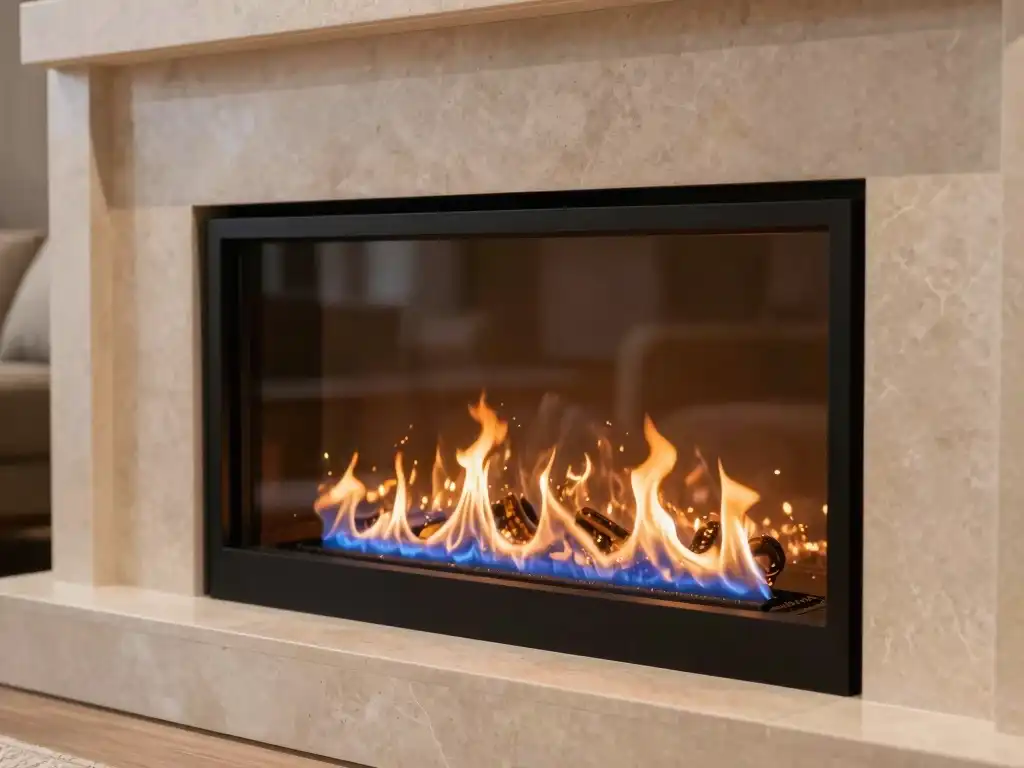
Ventless Gas Logs – No Chimney Needed, Full Heat in Kansas City Homes
Suppose the quote came back and the chimney rebuild was going to cost more than you wanted to spend – that doesn’t mean the fireplace is done. A fireplace without a chimney can be one of the most practical heat sources in a Kansas City home when it’s sized correctly, matched to the right firebox, and installed with the room in mind.
Why chimney-free heat works better than most people expect
Suppose the quote came back for a full chimney liner replacement and suddenly ventless gas logs went from a passing thought to a serious option. That shift makes sense, and here’s the counterintuitive part: a properly sized ventless log set can outperform a vented fireplace on raw room heat, because nothing escapes up a flue. Every BTU the burner produces stays inside the room. That’s not a sales pitch – that’s just combustion math, and it works in your favor when the setup is right.
Seventeen winters in Kansas City has taught me this: ventless systems keep more heat in the room because they do not send it up a flue, but here’s what really happens – that only feels good when the room can actually hold and circulate the warmth. Think of it like blocking a scene: heat enters from the firebox, it needs somewhere to move, somewhere to land, and somewhere to linger. When the room layout supports that movement, ventless logs are genuinely impressive. When it doesn’t, you get one warm face and a cold back. That distinction is the whole conversation.
| Option | Primary Purpose | Heat Delivered to Room | Chimney Needed | Best Fit in Kansas City Homes |
|---|---|---|---|---|
| Ventless Gas Logs | Real room heat with flame ambiance | High – nearly all BTUs stay in the room | No | Homes without a usable flue; supplemental heat rooms |
| Vented Gas Logs | Realistic flame appearance | Lower – significant heat exits through the flue | Yes | Homes with a working chimney that want a natural flame look |
| Open Wood-Burning Fireplace | Ambiance; some radiant heat | Inconsistent – drafts and open damper pull heat out | Yes | Homes that want a traditional experience and have a maintained chimney |
What decides whether the room feels warm or stuffy
Room volume matters more than showroom flame height
Here’s the part most homeowners get backwards. They walk into a showroom, see a tall dramatic flame, and assume that’s what they need. But the bigger log set doesn’t automatically mean better heating – what it usually means is a crowded firebox, an off-pattern flame, and a room that may hit uncomfortable CO₂ levels faster than expected. In a compact firebox and a medium-sized room, a properly sized, correctly rated burner will heat the space more evenly and more safely than an oversized set shoehorned into a box it wasn’t built for. The showroom flame is performing for a showroom, not for your living room.
I was in a Waldo living room once, and the homeowner was convinced he needed the largest log set on the market. His firebox was maybe 32 inches wide – not small, but not cavernous either – and the set he’d picked out online would’ve packed every log to the front edge with no room for proper flame development. I told him what I’d tell anybody: “On stage and in fireplaces, if every actor is shoved to the front, nobody looks good and nothing works right.” He laughed. We sized down to a set that fit the firebox correctly, and the flame was clean, even, and actually prettier than the oversized version would’ve been.
Brookside bungalows, Waldo ranches, older masonry fireboxes in homes built between 1940 and 1975 – Kansas City has a lot of them, and they all have their own ceiling heights, room proportions, and fireplace dimensions that change how ventless heat behaves. A room with a seven-foot ceiling holds and circulates warmth differently than one with nine-foot ceilings where heat rises and stalls. One practical field note: in a lot of these rooms, changing the ceiling fan direction to push warm air down and pulling one chair or sofa edge out of the direct heat path does more for comfort than upsizing the log set ever would.
| Myth | What Actually Happens |
|---|---|
| “Bigger log sets always heat better.” | Oversized sets crowd the firebox, disrupt flame pattern, and can force burner output beyond what the room should handle. Correct sizing beats raw size every time. |
| “No chimney means it must be unsafe by default.” | Ventless log sets are manufactured and tested to strict standards. Safety comes from using approved components, correct room sizing, and a proper installation – not from a chimney existing overhead. |
| “Ventless logs are only decorative.” | They can produce substantial heat output – often 20,000-40,000 BTU depending on the set – making them a legitimate supplemental heat source, not just something to look at. |
| “Any old firebox can take any ventless set.” | Firebox dimensions, gas line access, and clearance requirements all determine compatibility. A set that fits one firebox may be wrong for another even if they look similar in size. |
| “If the flame looks strong, the room will feel evenly heated.” | A strong flame produces heat. Whether that heat distributes evenly depends on room layout, ceiling height, furniture placement, and air circulation – not the flame height alone. |
- Matching burner size to firebox by eye alone – dimensions need to be measured, not eyeballed
- Blocking air openings in or around the firebox to “hold heat in” – that disrupts combustion and safety
- Ignoring manufacturer clearance requirements for combustibles around the unit
- Assuming a crowded or uneven flame pattern means the set is working harder for you – it means it’s working wrong
Installation choices affect both your comfort and your code compliance. These are not areas to improvise.
Can your fireplace opening actually take a ventless set
If you asked me this across your fireplace hearth, I’d say the question isn’t really about wishful thinking – it’s about four specific things: firebox dimensions, gas supply location and capacity, the condition of the firebox itself, and whether the product you want is approved for that application. My honest opinion: a smaller, properly matched set beats an oversized one every single time if the goal is real comfort rather than showroom drama. The homeowners who end up happiest are the ones who resisted the urge to go bigger and instead asked, “Does this set actually fit this box?”
A pretty flame in the wrong-sized box is still the wrong answer.
→ No: Ask about alternative gas fireplace insert or freestanding options.
→ Yes: Move to Step 2.
→ No: Don’t force a larger set – resize your selection to match the actual firebox dimensions.
→ Yes: Move to Step 3.
→ No: Schedule a gas line evaluation before ordering anything.
→ Yes: Move to Step 4.
→ No: Review room layout, ceiling fan direction, and circulation fixes before install.
→ Yes: Move to Step 5.
You’re ready to move forward with a professional evaluation and installation.
Firebox Width and Front-to-Rear Depth
Firebox Height and Interior Depth
Gas Line Type and Shutoff Access
Surrounding Clearances and Combustibles
Room Layout Factors Affecting Comfort
Where Kansas City homes usually need a little correction after install
Heat has to land somewhere, not just appear
Bluntly, heat doesn’t care what brochure you read. I remember a January install in Brookside, about 7:15 in the morning, when a retired couple had every blanket in the house piled on one sofa because their furnace was limping along. We lit the ventless set, and within twenty minutes the wife took off her cardigan and said, “So this is what one warm room feels like.” That’s the reason people in Kansas City ask about ventless gas logs – not to have something pretty to stare at, but because they want one room that’s genuinely, reliably warm. That’s a reasonable thing to want, and a properly installed ventless set can deliver it.
Think of the room like a stage with bad blocking – the heat enters from the firebox, but if the furniture crowds the front of the “stage” and the ceiling fan is pushing air the wrong direction, warmth has nowhere to stand. I got called out one evening during an early cold snap to a ranch home near Gladstone where the homeowner said the room felt “warm in the face and cold at the elbows.” That was exactly it: the ventless unit was putting out real heat, but the furniture arrangement had it stacking up right in front of the fireplace with no path to circulate into the rest of the room. The ceiling fan was spinning the wrong direction, pulling warm air up instead of pushing it back down. I adjusted the setup, shifted one chair, reversed the fan – and by the time I left, the room felt even. The log set wasn’t the problem. The blocking was.
Check the firebox interior for cracks, deterioration, and overall suitability. A damaged firebox doesn’t automatically disqualify you, but it needs to be documented and addressed.
Actual dimensions – not eyeballed estimates – are used to confirm the right log set and burner size for this specific firebox.
Verify gas type, line size, shutoff access, and whether the control system (manual, remote, or wall switch) is compatible and correctly positioned.
Log placement is not random. Manufacturer-specified patterns ensure clean combustion and proper flame character. The flame gets tested and observed before anything is signed off.
A quick look at circulation, fan direction, and furniture layout before leaving. Then a walkthrough so the homeowner knows how to operate, adjust, and safely shut off the unit.
- ☐ A clear photo of your fireplace opening – front face, inside, and the general surround
- ☐ Rough opening measurements: width, height, and front-to-rear depth if you can reach it
- ☐ Whether a gas line already exists near the fireplace – and natural gas or propane
- ☐ Whether the fireplace is masonry (brick/stone) or a prefabricated metal unit
- ☐ A general description of the room: approximate square footage and how it’s normally used
- ☐ Any existing comfort complaints in the room – drafts, uneven heat, cold spots – so those can be factored in from the start
Questions homeowners ask when they want heat without a remodel
By the time most people reach this point in the conversation, they’re not debating theory anymore. They want to know whether ventless gas logs will actually work in their room, with their fireplace, in their daily routine – and whether the investment makes sense before any work gets started. These are the questions that come up most on house calls around Kansas City.
If your Kansas City fireplace is sitting idle because the chimney isn’t usable, or you just want real heat in one room without a major renovation, call ChimneyKS for a ventless gas log evaluation – we’ll measure the firebox, check the room layout, and give you a straight answer on what will actually work. Reach out to ChimneyKS today and let’s figure out what your fireplace can actually do.