

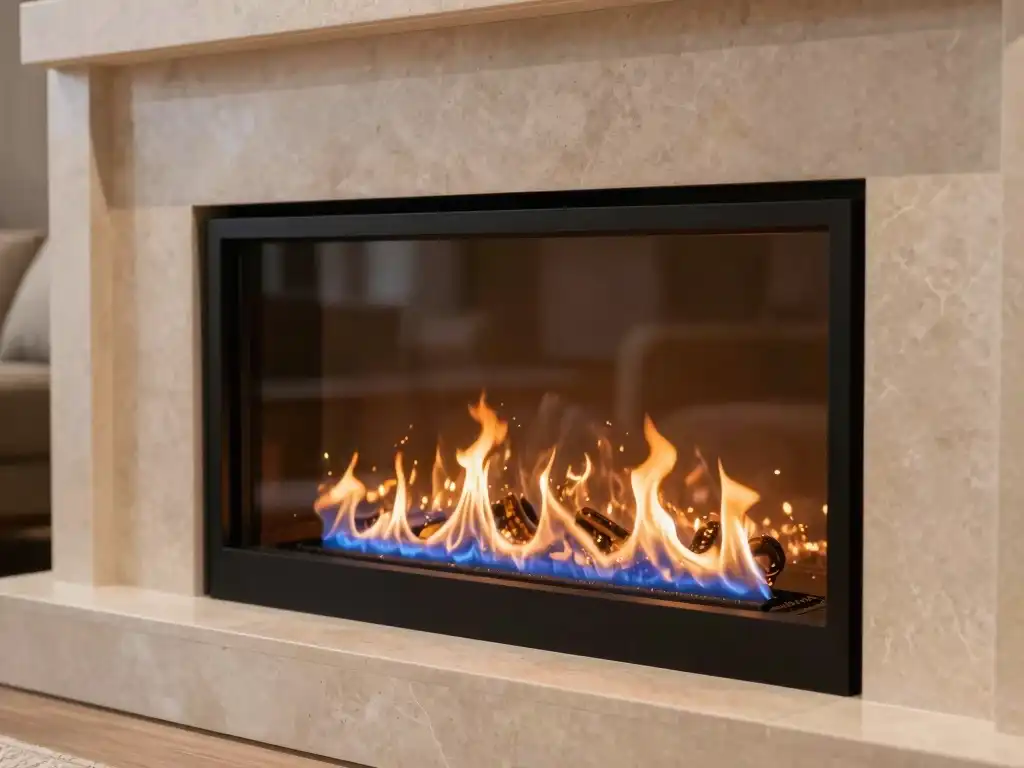
Clay Tile Liner Cracked or Failing? Here’s the KC Replacement Option
Beneath a perfectly normal-looking gas fireplace in Kansas City, there can be a clay tile liner with cracks big enough to leak exhaust directly into your home – and not a single puff of visible smoke will tip you off. That’s exactly why I treat every chimney like plumbing for invisible exhaust, and why this article will walk you through how to tell when that plumbing has failed and what the real replacement option looks like for KC homeowners.
Why Small Clay Tile Cracks Are a Big Deal with Gas Fireplaces
On more than one camera inspection in midtown KC, I’ve seen hairline cracks at the firebox that turned into pencil-wide gaps six feet further up the flue – gaps that were sitting right next to a bedroom wall, quietly doing nothing visible from the outside. My honest stance on this: if a liner can’t reliably carry all the exhaust to the sky, I call it unsafe. Even if that costs me an easy sweep job. A compromised gas liner isn’t a cosmetic masonry flaw. It’s a venting failure, full stop.
One January morning, about 7:15 a.m., I was on a roof in Overland Park with freezing drizzle hitting my glasses while I scoped a chimney for a retired teacher who’d just switched to a gas insert. The clay tile liner looked fine from the top – clean crown, no obvious spalling. But halfway down the camera showed a clean vertical crack big enough for me to slide a pencil through, right next to a second-floor nursery wall. That was the day I stopped trusting quick mirror checks for any gas fireplace liner in KC. Think of it like this: the chimney is plumbing for invisible exhaust. You wouldn’t look down a drain and guess whether the pipe behind the wall is cracked. You’d scope it.
Gas appliances are sneakier than wood fires in a compromised flue. Lower, steadier exhaust temperatures mean more acidic condensate forms inside a damaged liner, and those long quiet burn cycles push CO through every crack for hours at a stretch. I compare it to a car with a rusted exhaust section running under the passenger seat – you might not see anything wrong, but you’ll feel it sooner or later. And with CO, “feeling it” can mean a headache, or it can mean something worse.
⚠️ Why Cracked Clay Liners and Gas Don’t Mix
- Hot exhaust and carbon monoxide can leak through cracks into wall cavities, attics, or adjacent rooms instead of venting outside.
- Gas appliances often produce cooler exhaust than open wood fires, which condenses inside a damaged liner and speeds up tile failure.
- Small gaps in the flue can reduce draft, causing incomplete combustion and higher CO production at the appliance itself.
- Building and fire codes in the KC area require a continuous, intact flue for listed gas fireplaces and log sets – “mostly okay” doesn’t meet that standard.
How We Diagnose a Failing Clay Tile Liner in KC Homes
When I walk into a home and someone asks, “Is this crack really that serious?” my first question back is – what have the people in this house been noticing lately? I’ll never forget a late fall evening in Liberty, just after dark, when a landlord called me in a panic because his tenant complained of headaches after running a vented gas log all weekend. He wanted to know if the visible crack was “actually a problem.” I ran the camera and found three separate clay tile sections offset from each other, with gaps sending exhaust straight into the attic instead of outside. This was a typical 1920s-1960s KC masonry chimney – the kind that was built for coal or wood and then had a gas log retrofitted in at some point over the decades, no liner upgrade, no sizing check. That inspection is why I bring a CO monitor to every chimney liner for gas fireplace job in KC now, even when the customer tells me it’s been fine for years.
A mirror check or a glance up from the firebox doesn’t cut it – not for gas, not for anything with CO involved. The only way to actually know what’s going on is a Level 2 video inspection, CO and draft monitoring while the appliance runs, and a clear understanding of what’s tied into that flue. Is it just the gas log? An insert? A furnace? A water heater sharing the same stack? Each answer changes what we’re looking for. Think of it like scoping a drain line instead of guessing from the sink – you either know what’s in there, or you’re guessing.
Step-by-Step: Checking If Your Clay Liner Is Safe for a Gas Fireplace
-
1
Appliance inventory – Confirm exactly what’s tied into the chimney: gas log set, insert, furnace, boiler, or water heater. The answer affects everything downstream. -
2
CO and draft baseline – Use a carbon monoxide meter and draft gauge at the appliance to see how the system behaves under normal operating conditions. -
3
Full camera inspection – Run a video scope from bottom to top, documenting every crack, offset, missing tile, and debris accumulation. -
4
Wall and attic check – Inspect accessible chases, attics, and adjacent walls for scorch marks, staining, or odor paths that suggest exhaust migration. -
5
Code and sizing review – Compare the existing flue dimensions and condition with current code and manufacturer requirements for your specific gas unit. -
6
Liner replacement plan – Decide if a stainless liner is required, what diameter, and which sections of clay must be removed or bypassed before installation.
🔍 Red Flags Your Clay Liner Shouldn’t Be Venting Gas
- CO alarms that chirp or spike when the gas fireplace or log set runs.
- Soot streaks, white efflorescence, or heat shadows on walls near the chimney chase.
- Debris or tile shards falling into the firebox or landing on the smoke shelf.
- Visible cracks or gaps in tiles at the firebox throat or anywhere you can see up into the flue.
- Strong exhaust or metallic smells in the room or attic instead of at the top of the chimney.
Stainless Steel Relining – The Go-To Fix for Gas Fireplaces in KC
I still remember the first time I watched a clay tile liner crumble as we pulled the new stainless liner through it – a few summers back, during one of those 100-degree KC days in Waldo where the air was so still you could hear the highway from miles away. We were halfway through a 1920s chimney relining when the old tiles started collapsing like dominos inside the flue, blocking the liner’s path entirely. I spent two extra hours on that roof in the heat, carefully breaking out shards so they didn’t punch into the neighbor’s side of the shared chase. That job is why I now tell every customer upfront: a “simple” clay liner replacement can turn surgical mid-job, and you want someone running the project who expects that possibility, not someone who gets surprised by it.
Here’s the thing about a properly installed stainless steel liner – it becomes a brand-new smooth exhaust pipe running inside the old masonry structure. Fewer joints, better draft, and it can be matched exactly to your gas fireplace’s BTU rating and venting category. I compare it to replacing a corroded HVAC duct or a rusted exhaust section with a continuous stainless run. And honestly, the insider tip worth sharing here: liners for gas appliances are usually smaller in diameter than what the old clay tiles were sized for. “Bigger is better” is a red flag in any bid you get. The liner has to match the appliance BTUs, the chimney height, and the venting category – or the draft won’t work right no matter how shiny the new metal is.
| Feature | Old Clay Tile Liner | New Stainless Steel Liner |
|---|---|---|
| Shape & surface | Square or rectangular, rough mortar joints throughout | Round or oval, smooth continuous interior surface |
| Condition in older KC homes | Cracked, offset, or partially collapsed in common in pre-1970 chimneys | Continuous run, sized to the specific gas appliance it serves |
| Gas compatibility | Designed for old wood or coal appliances; often oversized for modern gas | UL-listed for gas appliances; matched to BTUs and venting category |
| Repairability | Cracks deep in the flue are hard to access and harder to patch reliably | Can be inspected, cleaned, or replaced as a unit if a section is damaged |
| CO & draft performance | Leaks and inconsistent draft common once tiles start to fail | Tighter system with more predictable draft and CO management when correctly sized |
If exhaust can see daylight anywhere inside your chimney walls, so can carbon monoxide.
💰 Typical KC Price Ranges for Gas Fireplace Relining
| Scenario | Description | Estimated Range (KC) |
|---|---|---|
| Short interior chimney, one gas fireplace | Single-story or ranch home, minimal tile removal, straight flue run | $1,800 – $3,000 |
| Two-story masonry chimney, moderate tile damage | Standard 1920s-1960s KC home, some tile breakout, stainless liner sized for gas insert or logs | $2,800 – $4,500 |
| Tall or offset chimney with heavy clay collapse | Multiple offsets, extensive tile removal from the roof, possibly shared with other appliances | $4,500 – $7,000 |
| Gas fireplace plus additional gas appliance on same flue | Requires reconfiguring venting and possibly adding a separate liner or new vent run | $3,500 – $6,500 |
Is Repair Enough, or Do You Need a Full Liner Replacement?
Here’s my honest opinion, even if it costs me a job or two: for gas appliances venting into older clay, spot repairs – mortar patches, ceramic coatings, spray-in resurfacing – might buy a little time on very minor surface damage, but they rarely restore a continuous, code-compliant flue once cracks and tile offsets are significant. The decision I walk every KC homeowner through comes down to four things: how long the crack runs, where it sits in the flue relative to walls and attic spaces, what BTU load the gas appliance is pushing, and how much of the liner has already shifted or failed. One isolated crack near the base of a well-maintained chimney is a different conversation than three offset tiles with gaps inside a shared interior wall. And if there have been any CO events – alarms chirping, headaches, weird smells – that moves straight to replacement, no debate.
🌿 Should You Repair or Replace Your Chimney Liner for a Gas Fireplace in KC?
Start: Do you have a gas log set or gas insert venting into a clay tile chimney?
➜ Yes → Has a camera inspection found any cracks, gaps, or missing tiles?
➜ No → Continue annual inspections. Liner is likely safe for now.
➜ Yes → Are the cracks short, isolated, and away from wall cavities or attic spaces?
➜ Yes → Discuss limited repair options and increased monitoring, but plan for eventual stainless relining.
➜ No (long cracks, offsets, or multiple damaged tiles) → Full stainless liner replacement strongly recommended for continued gas use.
Also ask: Any CO alarm events, headaches, or strange exhaust odors? If yes, treat it as a replacement-level safety issue immediately – don’t wait for the next inspection window.
KC Homeowner Questions About Gas Fireplace Liners, Answered
Most of the questions I field come down to three themes: does a gas fireplace with small flames really need a solid liner, how long will a new stainless liner hold up in a KC climate, and whether someone can keep using their fireplace while they’re still thinking it over. I answer all three carefully, because convenience isn’t the right lens when CO is involved. Here’s how I’d answer them if you were sitting across from me right now.
A gas fireplace is only as safe as the liner carrying its exhaust out of your house – and clay tiles in older KC chimneys rarely age gracefully, especially once gas logs or inserts enter the picture. If anything in this article sounds familiar, don’t sit on it. Call ChimneyKS to schedule a camera inspection and get a straight answer – whether that means continued monitoring or a stainless chimney liner for gas fireplace KC homeowners can trust for the next few decades.