

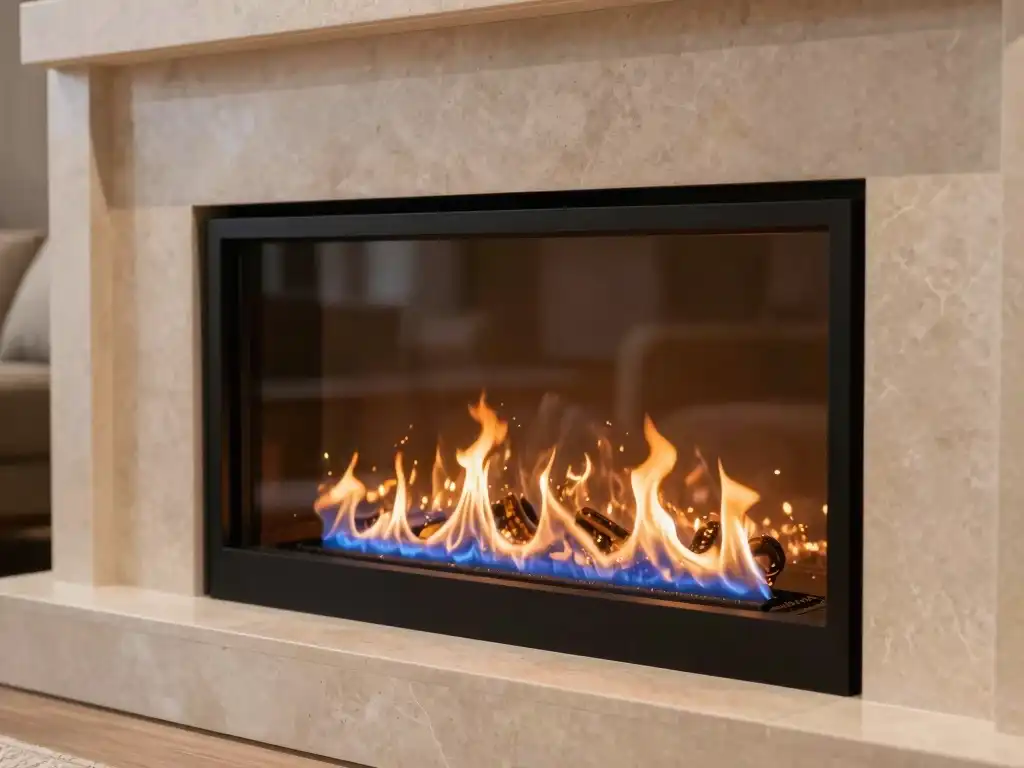
Wood Burning Stove Needs Sweeping Too – Here’s the KC Option
Go look at the inside of your wood burning stove sometime – it’s probably cleaner-looking than you’d expect, especially compared to an open masonry fireplace. That’s exactly the problem, because what’s happening above the stove, inside the connector pipe and flue, doesn’t care how tidy the firebox looks. Kansas City homeowners who heat with a wood stove often assume the neat, controlled burn means the chimney is staying neat too, and that assumption is what keeps chimney sweep for wood burning stove calls coming to my phone every fall.
Why a tidy-burning stove still leaves a dirty flue
Seventeen years in, the fastest way I spot trouble is still by what’s hiding above the stove, not inside it. Wood stoves earn a reputation for burning clean – and compared to an open fireplace, they often do. But that cleaner burn happens in the firebox. The flue above it is a different environment, and it’s doing a different job. Gases and particulates rising out of a stove still cool down as they travel up the connector pipe and into the chimney, and that cooling is exactly where creosote finds a surface to grab. The stove looks fine. The firebox looks manageable. The bottleneck is somewhere between the stove collar and the top of the flue, and nobody’s looked there in two years.
Here’s the blunt part: a wood stove owner can do almost everything right and still end up overdue for a sweep. Burning hardwood, keeping a decent fire, not letting it smolder all night – these are good habits. That sounds reasonable, but it’s not how the flue behaves. Startup cycles, the slow burn you leave before bed, the slightly damp cord wood from the guy down the street, the oversized flue that doesn’t stay warm between fires – any of these can tip a system toward faster deposit buildup than the firebox would ever suggest. Appearance is misleading. The flue behaves on its own schedule.
| Myth | Fact |
|---|---|
| Wood stoves burn too hot to need sweeping often. | High-temperature burns reduce some deposits, but startup cycles, low-burn periods, and cool-downs still allow creosote to accumulate – especially in the connector pipe and upper flue where temperatures drop fast. |
| If I don’t see smoke indoors, the flue is fine. | Significant narrowing can occur before any smoke enters the living space. The first sign is often a subtle draft change or slightly blackened glass – not visible smoke. By the time smoke enters the room, the problem is already well developed. |
| Only fireplaces get creosote problems. | Wood stoves and their connector pipes are just as vulnerable – and in some cases more so, because the narrower diameter of stove pipe means even moderate buildup has a bigger impact on draft performance. |
| A newer stove means a cleaner chimney. | Stove age has almost nothing to do with flue condition. What matters is fuel quality, burn habits, and flue design. A brand-new stove fed damp wood in an oversized liner will produce heavy deposits quickly. |
| Burning less often means I can skip inspections. | Low-use systems can still develop glazed creosote from the few burns that do happen – especially if those burns start cold and smolder. An annual look is still warranted regardless of frequency, and critters and moisture can cause problems even in an idle flue. |
Quick Facts – Wood Stove Sweep
Service Focus
Wood stove chimney and connector pipe sweeping
Risk Driver
Creosote narrows airflow before homeowners notice any problem
Best Timing
Before heavy winter use – late summer or early fall
Local Concern
Damp shoulder-season burning raises deposit risk in KC homes
Signs the bottleneck has already started
Draft clues homeowners miss first
Last January on a Waldo roof, I watched a “small problem” turn into a smoke-back lesson in about ten minutes. Retired couple, older two-story, wood stove they’d been using for close to a decade. Every windy night, smoke would push back into the living room – not constantly, just when the wind hit right. They’d adjusted the damper, tried burning hotter, even replaced the cap. None of it fixed it. I ran the camera and the issue was clear: the flue had narrowed enough that it could handle normal draft just fine, but the moment outside wind pressure shifted, it couldn’t compensate. That partial narrowing only becomes visible when conditions change. Five extra minutes with a camera, in that case, was the whole diagnosis. No wind that day on the roof, but the camera showed exactly what the wind was exposing every night.
A chimney works a lot like an organ pipe, and once the passage gets narrowed, the whole performance goes off-key. I spent years before this trade restoring pipe organs in old Missouri and Kansas churches – strange preparation for chimney work, but honestly the physics are close enough that I still think in those terms. An organ pipe produces its tone because air moves through a carefully sized passage with nothing interrupting it. Change the geometry, even slightly, and the pipe misfires or goes flat. A chimney flue is doing the same thing: it’s moving air with a purpose, and any buildup that changes the cross-section changes the behavior. The older housing stock in neighborhoods like Waldo, Brookside, and Midtown often has flue geometry that was designed for different heating equipment – and it doesn’t forgive neglect the way a more forgiving modern system might. Listen for the bottleneck.
| What You Notice | Likely Flue or Stove-Pipe Issue | How Soon to Schedule Sweeping |
|---|---|---|
| Glass blackening fast | Poor draft, incomplete combustion, or a partially restricted connector pipe causing gases to linger near the door | Soon – don’t delay |
| Smoke puff on startup | Cold flue or restricted upper flue slowing the initial draft establishment | Before next season |
| Stove harder to keep lit | Reduced draft from buildup limiting oxygen supply to the firebox | Schedule now |
| Strong odor after a burn | Creosote or soot deposits releasing odor during temperature changes – often worse in humid weather | Before next use |
| Smoke enters room on windy nights | Narrowed flue can’t compensate for wind-induced pressure changes – a buildup problem exposed by weather | Immediately |
⚠ Don’t Judge Chimney Condition by the Firebox Alone
The visible stove interior – the firebox, the glass, the grates – can look completely manageable while glazed creosote is quietly accumulating higher up in the connector pipe or flue liner where you’d never think to look during a casual inspection. Shiny or tar-like glaze is not a brush-it-later situation – glazed creosote is harder to remove, burns hotter if ignited, and doesn’t respond to standard sweeping the same way softer deposits do.
What changes how fast buildup forms
Wood moisture matters more than most owners think
What do I ask first? “What kind of wood are you burning, and are you sure it’s actually dry?” Every time. I remember a 6:40 a.m. call in Brookside during the first cold snap of November – homeowner swore the wood stove was “basically new,” barely two seasons old, so it couldn’t possibly need sweeping. I opened the connector pipe and pulled out glazed creosote thick enough to peel in strips. They’d been buying hedge rounds from a neighbor, burning them after barely a season of drying, and doing long overnight burns to get through the cold. The stove itself looked fine. The connector pipe told a completely different story. They thought the chimney only mattered if they had a full masonry fireplace, which is one of the most common assumptions I run into – and one of the most wrong ones.
At the connector pipe, the story usually gets more honest than the living room does. That section between the stove collar and the flue tile is where temperature drops first, where gases slow down, and where the first evidence of a problem lands. Flaky, dry soot brushes out easily and usually means decent combustion with reasonably dry wood. Crunchy creosote – darker, harder, somewhat granular – means the fire’s been running cooler or the wood wetter than ideal. Glazed creosote is the one you really don’t want to find: it’s shiny, it’s sticky or hard as lacquer, and it forms when low-temperature smoldering is the norm. A quick look at the connector pipe before the full flue evaluation will tell you what kind of sweep you’re actually dealing with. If service skips that section, the evaluation isn’t complete.
Your stove habits, your wood source, and your winter schedule are writing the story inside that pipe every single time you burn. Listen for the bottleneck.
Conditions That Speed Up Sweeping Needs
- ✅ Unseasoned or damp wood – moisture in the fuel is the single fastest route to heavy creosote deposits in the connector pipe and flue
- ✅ Low smolder burns – long, cool overnight fires let gases linger in the flue instead of drafting cleanly, leaving deposits on every surface
- ✅ Oversized flue – a flue liner that’s too large for the stove output stays cooler, slows the draft, and accumulates deposits faster than a properly sized liner would
- ✅ Long shoulder-season use – burning in mild weather means smaller, cooler fires that don’t develop enough draft to carry combustion byproducts cleanly out of the system
- ✅ Short hot fires followed by cool-downs – repeated rapid temperature cycling causes condensation in the flue, which helps creosote stick and harden faster
- ✅ Neglected connector pipe cleaning – skipping the pipe section during service leaves the highest-deposit zone untouched, letting buildup progress unchecked between appointments
Flaky Soot, Crunchy Creosote, and Glazed Buildup – What’s the Difference?
When to book sweeping in Kansas City and what the visit should include
Kansas City’s first real cold snap has a way of arriving in about a 48-hour window sometime in late October or early November, and the chimney sweep for wood burning stove calls that follow are predictable enough that I could set a calendar by them. The homeowners who called in August and September got easy scheduling. The ones who called the day after the first frost waited longer, sometimes into December. And then there’s the post-holiday rush – people who hosted family, burned the stove every night for a week straight, and are now noticing things feel off. Early fall is the right window for KC households. The older neighborhoods like Brookside, Waldo, and Midtown have a lot of homes where the stove is genuinely the warmest room in the house on a cold night, and those systems are working harder than the homeowner always realizes. Book before the shoulder-season burns pile up.
A proper appointment is more than a quick brush pass and a handshake. A Saturday just before Christmas, I had a customer in Midtown who needed the stove going that evening for family coming over – grandkids preferred it to the furnace, apparently. When I ran the brush, I pulled down so much flaky soot and crunchy creosote that the homeowner went quiet and said, “We thought sweeping was for fireplaces, not stove pipes.” That sentence is probably why I still write articles like this one. Proper service means checking the connector pipe closely, inspecting accessible components before and after cleaning, verifying the cap and termination aren’t contributing to the problem, and then explaining what was found in plain terms – not just handing over an invoice and leaving. If the technician doesn’t give you a clear picture of what was removed and when to expect the next service, you don’t have a complete answer.
| Timing | Task | Who Needs It Most |
|---|---|---|
| Pre-season (Aug-Oct) | Full inspection and sweep if overdue – clear the connector pipe and flue before regular burning begins | Every wood stove household – especially those that burned through the previous winter |
| Mid-season check (Dec-Jan) | Interim inspection for heavy burners – visual check of connector pipe and draft performance | Households burning 4+ nights per week or using damp or mixed wood sources |
| After any smoky event | Sweep and camera inspection – don’t keep burning after smoke-back episodes without understanding the cause | Anyone who’s had smoke enter the living space, even once |
| End of season (Mar-Apr) | Condition review – assess deposit level and moisture situation before closing the stove for warm months | Useful for planning: if the end-of-season review shows heavy deposits, the pre-season sweep is non-negotiable |
| Annual camera review | Full camera inspection of the flue – especially when draft complaints repeat year over year despite regular sweeping | Older KC homes with original tile flues, previously rellined systems, or any stove with chronic performance issues |
What a Proper Wood Stove Chimney Sweep Appointment Should Cover
Wood species, moisture level, burn frequency, overnight smoldering habits – this context shapes everything that comes next and tells you what deposit type to expect before you open anything.
The connector pipe between the stove collar and the flue entry gets checked closely – deposit type, accumulation level, any sign of corrosion or joint separation. This is where the honest evaluation begins.
Brushing technique, equipment, and chemical pre-treatment (if needed) should match what’s actually in the flue – not just the same standard pass used on every job regardless of conditions.
A damaged or missing cap, a deteriorating spark arrestor, or debris blockage at the termination can undermine an otherwise clean flue – and it’s an easy thing to confirm while equipment is already out.
What was found, what was removed, what condition the system is in now, and when it should be looked at again – in plain terms, not boilerplate language. You deserve to understand what just happened in your chimney.
Common Questions
How often does a wood burning stove chimney need sweeping?
Can I just clean the stove pipe myself and skip the chimney?
Why does my stove smoke only on windy nights?
Is sweeping still necessary if I barely used the stove last year?
If your stove has been showing any smoke quirks, odor after burns, glass that blacks up too fast, or it’s simply been longer than you can remember since someone swept it – ChimneyKS can inspect and sweep the full system before the bottleneck turns into a bigger problem. Call before the cold snap hits and the schedule fills up.