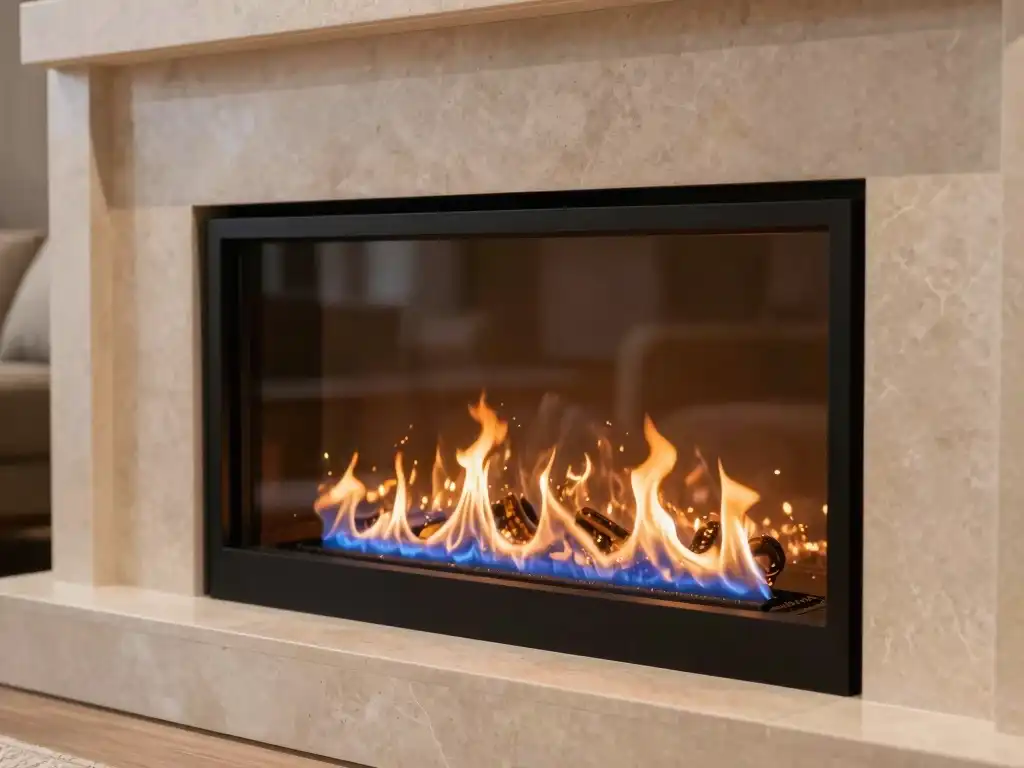
Sealed Combustion Fireplaces – Superior Efficiency for Kansas City Homes
Sometimes you just know, the moment you walk into a living room where the fireplace is running, that something is off-the room feels colder near the floor, the furnace is humming away in the background, and the flames look just fine. Some traditional fireplaces actually pull conditioned indoor air out of the house as they burn, leaving you colder than before you lit them. A sealed combustion system pulls outside air directly for the burn instead, and that one change rewrites the efficiency equation for a lot of Kansas City homes.
Why old fireplaces can work against your furnace
Here’s my blunt take: if the fireplace steals heated room air, you’re losing the argument before winter really starts. Visible flames don’t guarantee useful heat-not even close. An open fireplace or one that depends on room air to feed combustion is pulling warmed air out of your living space and sending it up the flue, then forcing your furnace to replace all that lost heat. Think of it like a speaker box with a loose panel. You can crank the volume, but half the output bleeds out through the gap before it ever reaches your ears. A fire with the wrong air feed works exactly the same way-it looks impressive and wastes energy at the same time. And honestly, that bothers me every single time I see it.
I remember one sleety Tuesday around 7:15 in the morning in Waldo, standing in a living room with my boots leaving salt marks on hardwood, while a homeowner told me her old fireplace “heated great” even though the furnace had been running nonstop all night. Once I checked the draft and outside air relationship, it was obvious the fireplace was basically acting like an exhaust fan with decorations. The fire looked active, the glass felt warm, and the house was quietly bleeding conditioned air up the chimney every minute the thing ran. Sealed combustion is the practical correction to that problem-not a cosmetic upgrade, not a luxury feature. It’s the fix for a setup that’s working against itself.
Myth vs. Fact: What Kansas City Homeowners Often Get Wrong About Fireplace Heat
| Myth |
Fact |
| If it feels warm near the hearth, the room is being heated well. |
Radiant heat close to the unit doesn’t mean the whole room benefits. If the fireplace is drawing room air, corners and far walls often cool down while the hearth area feels warm. |
| All gas fireplaces are automatically efficient. |
Gas fuel doesn’t equal efficient design. A gas fireplace that pulls combustion air from inside the house still creates negative pressure and heat loss, regardless of the fuel type. |
| A bigger flame means better heating performance. |
Flame size reflects fuel consumption, not heat delivery to the room. A larger flame drawing room air can actually accelerate indoor air loss and make the house feel colder overall. |
| Draftiness during fireplace use is just an old-house issue. |
Age is rarely the real cause. Drafts during fireplace use usually point to negative pressure-the fire is consuming room air faster than it can be replaced, pulling cold air in through gaps and door frames. |
| Outside air kits and sealed combustion are basically the same thing. |
They’re not. An outside air kit feeds air near the firebox opening but doesn’t isolate combustion from the room. A sealed combustion system fully separates the combustion process from indoor air, which is a fundamentally different design. |
Quick Orientation: Sealed Combustion Fireplace Installation in Kansas City
Best Fit
Older or draft-prone homes-especially those with partial updates, added insulation, or tightened envelopes that made existing fireplaces perform worse.
Air Source
Outside combustion air piped directly to the appliance, completely bypassing indoor air supply.
Comfort Effect
Less indoor air theft means steadier temperatures throughout the house, not just near the hearth.
Typical Goal
More reliable heat delivery without pulling the house into negative pressure or making the furnace pick up the slack.
How sealed combustion changes the pressure game
What’s feeding the fire right now-outside air, or the air you already paid to heat?
What’s feeding the fire right now-outside air, or the air you already paid to heat? That question is the whole ballgame with sealed combustion. The appliance draws outside air through a dedicated pipe for the burn, then vents combustion gases through a separate sealed path, so the system never has to tug at your indoor air supply to keep going. The result is a fireplace that doesn’t compete with your house for pressure. In Brookside, Waldo, and mid-century Kansas City neighborhoods where homes have been partially updated-new windows here, added insulation there, but the same old fireplace-that tug-of-war is often what people are blaming on “drafty old bones” when it’s really a venting and air-source problem hiding in plain sight.
That sounds right, but here’s the part people miss: a newer insert doesn’t automatically fix the problem just because it’s newer. One December evening, right before a Chiefs game kickoff, I got called to a Brookside house where the customer swore the new insert was defective because the den felt colder every time they used it. The issue wasn’t the unit-it was that the surrounding setup and air movement in that older home were fighting the appliance. After we talked through sealed combustion versus room-air dependence, you could see the lightbulb come on before I even finished the sentence. The hardware can be fine and the result can still be poor if the house conditions aren’t accounted for in the installation plan.
Here’s a comparison I use a lot: giving a sealed combustion fireplace a dedicated outside-air feed is like plugging an amplifier into a clean, isolated power source and sealing the cabinet tight. No bleed, no pressure leak, no wasted output. A room-air-dependent unit is the same amp running off a shared circuit with loose panels on every side-you get noise, loss, and frustration instead of performance. And here’s the insider detail that surprises people: you’ll often notice the improvement first in the room next to the fireplace, or down near the floor, not standing right in front of the hearth. That’s where the pressure difference shows up first, and it’s a reliable early sign that the system is actually working the way it should.
If the fire has to borrow your living room air to keep going, the house is helping pay for its own heat loss.
Sealed Combustion vs. Room-Air-Dependent Fireplaces
| |
Sealed Combustion |
Room-Air-Dependent |
| Combustion Air Source |
Dedicated pipe from outside the home |
Draws from indoor living space |
| Effect on Indoor Pressure |
Minimal impact; house stays near neutral pressure |
Can pull house into negative pressure, drawing cold air through gaps |
| Comfort in Adjacent Rooms |
Typically more even; floor-level drafts reduced |
Often worse; nearby rooms and floors cool down as the fire runs |
| Efficiency Tendency |
Higher; most of the heat goes into the room, not up the flue replacing stolen air |
Lower; furnace often runs more to compensate for lost conditioned air |
| Draft Sensitivity |
More stable; isolated system is less affected by house pressure swings |
More vulnerable; household pressure changes affect draft and performance |
| Compatibility with Tighter Homes |
Well-suited; designed for homes with reduced natural air infiltration |
Problems get worse as homes are air-sealed; less makeup air available |
Should Your Kansas City Home Be Evaluated for Sealed Combustion Fireplace Installation?
Do rooms feel drafty when the fireplace runs?
YES ↓
NO ↓
Does the furnace seem to run more during fireplace use?
YES ↓
NO ↓
Schedule evaluation for pressure and venting
Is the current unit older, open, or dependent on room air?
YES → Evaluation recommended
Do you want better heat retention and fewer comfort swings?
YES ↓
NO ↓
Schedule evaluation for sealed combustion options
Maintenance and efficiency review may still help
Signs your current setup is leaking comfort
Truth is, a pretty fireplace can behave like a leaky speaker box. The cabinet looks right, the flame looks right, but the pressure is bleeding out through every gap and the room never gets the output it should. What you’ll actually notice-if you pay attention-is colder far corners while the hearth is warm, floor-level drafts that appear out of nowhere after ignition, the den cooling down ten minutes after you lit the fire, the furnace kicking on harder and staying on longer, and a fire that looks genuinely impressive while delivering heat only to the two feet of space directly in front of it. If any of that sounds familiar, the table below is a good place to start sorting out what’s actually going on.
Fireplace Performance Symptom Guide
| What You Notice |
What It Usually Means |
Best Next Move |
| Room feels colder after fireplace starts |
Fireplace is drawing room air for combustion faster than the house can replace it, creating a net heat loss |
Evaluate combustion air source and venting setup |
| Smoke, odor, or inconsistent draft |
Negative indoor pressure is reversing or weakening draft, a classic sign the house is going negative when the fire runs |
Pressure and draft inspection; may need sealed combustion to stabilize |
| Furnace runs more during fireplace use |
Fireplace is consuming conditioned air; furnace compensates by running extra cycles to maintain temperature |
Assess air-source design and whether sealed combustion would break the cycle |
| Strong heat near unit, poor whole-room comfort |
Radiant output at the hearth doesn’t translate to room distribution; pressure loss is pulling warmth out before it spreads |
Review appliance type, venting, and air balance; sealed combustion often resolves this |
| Comfort complaints after remodels or air-sealing work |
Tightening the envelope reduces makeup air, making room-air-dependent fireplaces worse; a problem that gets blamed on the remodel instead of the appliance |
Sealed combustion evaluation is the right starting point |
⚠ Don’t Judge Performance by the Flame
Flame size, warm glass, and radiant heat directly in front of the unit are not reliable indicators of how a fireplace is performing for the house as a whole. Pressure balance, venting design, and air source are the factors that determine whether the room-and the rooms around it-actually benefit from the fire running. A big, beautiful flame in a poorly configured setup can actively make things worse.
Where installation details decide whether the upgrade pays off
Picture trying to run a sound system with somebody cutting holes in the cabinet while the music’s playing.
The appliance alone isn’t the whole answer-not even close. That’s the part people don’t realize when they’ve done some research online and picked out a unit they like. Vent routing matters. Chase conditions matter. Framing clearances, outside-air pipe integrity, and how well the install gets sealed at every penetration all determine whether the efficiency you’re paying for actually shows up in how the house feels. A sealed combustion fireplace installed with a compromised vent path or a leaky outside-air connection is giving up performance the same way a sealed enclosure gives up output through a bad seam. The hardware can be right and the result can still disappoint if the installation details don’t follow through.
I once spent part of a windy Saturday in Lee’s Summit with a retired saxophone player who understood my airflow explanation faster than almost anybody because I compared combustion air to an instrument needing the right feed and pressure. We were in his sunroom-the kind with too much glass and not enough insulation-and his old fireplace was losing the battle before it even started. When I showed him how a sealed combustion system isolates that process, he laughed and said, “So my old fireplace was playing out of tune.” Exactly. Glass-heavy rooms, sunrooms, and additions are brutal to under-designed setups because every pressure and temperature swing in that space works against a room-air-dependent unit. Sealed combustion doesn’t eliminate the challenge, but it stops the fireplace from fighting itself while it’s already fighting the room.
What a Proper Sealed Combustion Installation Evaluation Should Cover
1
Inspect current fireplace and venting type. Identify whether the existing unit is open, has a room-air dependency, or already has some outside-air provision-and what condition the flue or vent system is in.
2
Assess room pressure behavior and likely air pathways. Check how the house responds during fireplace operation-where it goes negative, what gaps are pulling, and how makeup air currently moves through the space.
3
Verify vent route and exterior termination options. Confirm that a sealed combustion system can be properly routed, that the termination point is practical and code-compliant, and that no existing chase conditions will compromise the install.
4
Match appliance size and output to room and home layout. An oversized or undersized unit creates its own problems. The right appliance for the space, the ceiling height, and the surrounding rooms matters as much as the technology type.
5
Confirm finishing and sealing details that protect efficiency. Every penetration, every gap around the insert, and every connection in the outside-air pathway has to be properly addressed-because this is where promised efficiency either survives or gets handed back.
Before You Call About Sealed Combustion Fireplace Installation KC – Gather This First
-
☐
Approximate age of your current fireplace – even a rough decade helps narrow down what you likely have installed.
-
☐
Fuel type – wood or gas – and whether it’s a built-in unit, insert, or freestanding stove.
-
☐
Photos of the fireplace front and vent or chimney area – a quick phone photo of the surround, the chase top if accessible, and any visible vent pipes saves time.
-
☐
Notes on drafty rooms – which rooms, what floors, and whether it happens consistently or only during certain conditions.
-
☐
Whether comfort seems to get worse when the unit runs – colder rooms, furnace running more, floor drafts appearing after ignition.
-
☐
Any remodel or air-sealing work done on the home – new windows, added insulation, spray foam, or HVAC upgrades that changed how tight the house is.
Questions Kansas City homeowners ask before making the switch
People usually want to know whether this is about comfort, efficiency, safety, or all three-and the honest answer is that it depends on what’s happening in your specific house. Here are the questions that come up most often.
Sealed Combustion Fireplace Installation KC – Common Questions
Is sealed combustion always more efficient than a traditional fireplace?
Not automatically. Sealed combustion removes a major efficiency drain-room-air consumption-but the overall efficiency of the system still depends on insulation, vent integrity, appliance quality, and how well the install was done. That said, for most Kansas City homes running an older room-air-dependent unit, the improvement is real and noticeable.
Can sealed combustion help if my house only feels drafty when the fireplace is running?
That symptom is one of the clearest signs the current setup is pulling house pressure negative. Sealed combustion directly addresses that by removing the competition between the fire and your indoor air. Whether it fully solves the issue depends on whether there are other contributing factors, which is why a pressure evaluation is worth doing first.
Does sealed combustion make sense in older Kansas City homes?
It often makes the most sense there. Older Brookside, Waldo, and midtown homes with partial updates are exactly the type where room-air-dependent fireplaces cause the most problems-the house is tight in some areas and leaky in others, and pressure behavior gets unpredictable. Sealed combustion stabilizes that situation rather than fighting it.
Will I need chimney or vent modifications to make this work?
Likely some, yes. Sealed combustion systems use a dedicated coaxial or separate pipe system for both combustion air intake and exhaust, which is different from a standard flue. Depending on your existing setup, modifications to the chase, liner, or termination point may be part of the job. That’s why vent routing gets evaluated before any appliance gets selected.
How do I know whether the problem is the appliance or the airflow conditions around it?
That’s the most important question, and it’s one you usually can’t answer from the fireplace itself. A proper evaluation looks at house pressure behavior, not just the unit. Sometimes the appliance is fine and the surrounding conditions are the issue. Sometimes it’s both. Getting the diagnosis right before replacing anything saves time, money, and the frustration of swapping hardware and still having the same comfort problems.
Why Homeowners Call a Specialist Instead of Guessing
-
✔
Venting-focused diagnosis – A chimney specialist looks at the whole air and venting picture, not just the appliance in front of them. Pressure, draft, and vent path get evaluated together.
-
✔
Familiarity with older Kansas City housing stock – Homes in Brookside, Waldo, Waldo, Lee’s Summit, and similar areas have specific quirks that affect fireplace and venting performance. Experience with that stock matters.
-
✔
Ability to spot pressure-related comfort losses – The symptom is usually a comfort complaint. The cause is usually airflow and pressure. Connecting those two requires knowing what to look for beyond the flame.
-
✔
Clear explanation of options without a one-size-fits-all recommendation – The right solution depends on the house, not a sales preference. You’ll get an honest read on whether sealed combustion makes sense for your specific setup.
If your fireplace looks great but your furnace runs nonstop every time you use it, or the den gets colder instead of warmer after ignition, it’s worth having the venting and airflow evaluated before next winter. Call ChimneyKS and let’s figure out whether your current setup is delivering heat or stealing it-and what it would take to change that.