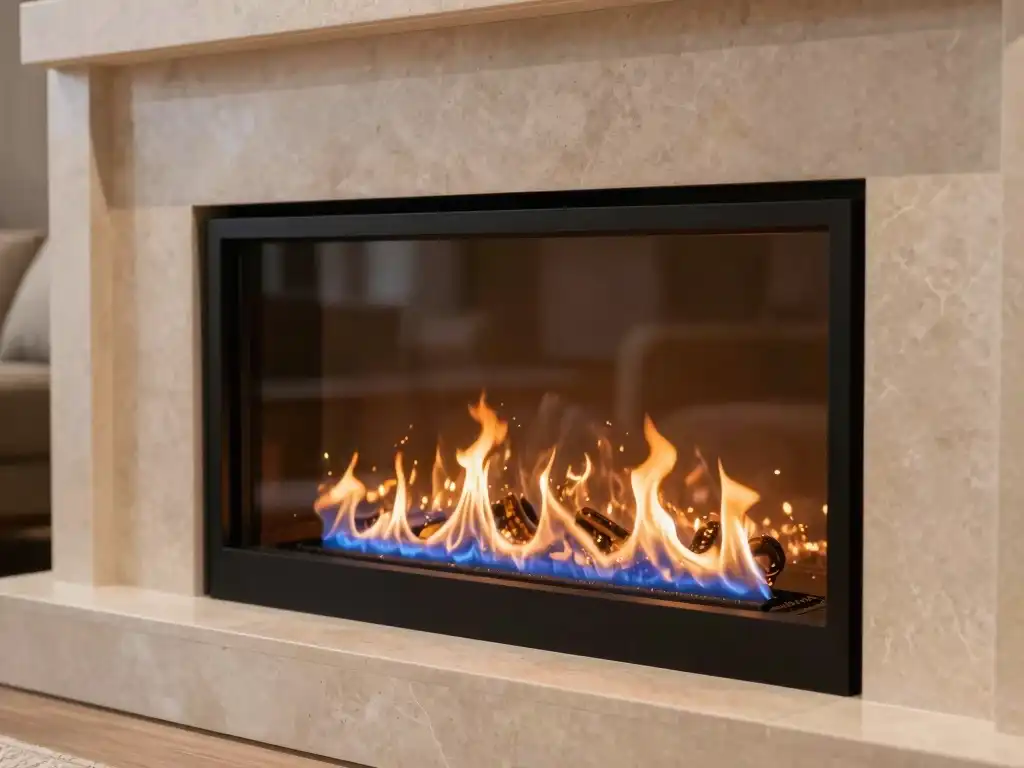
Gas Fireplace Cleaning – Removing Dust, Residue, and Buildup in Kansas City
Hidden inside every “clean-burning” gas fireplace in Kansas City is a slow accumulation of combustion film, household dust, and the residue from every candle and air freshener that ever burned in that room-coating the glass, choking the burner ports, and quietly building toward a performance problem or a safety issue you won’t see coming. I’ve been working on gas fireplaces and chimneys in this city for 27 years, and the way I look at it, a real gas fireplace cleaning is a system tune-up-inputs, outputs, failure points-not just a wipe of the glass before company arrives.
Why “Clean-Burning” Gas Fireplaces Still Need Real Cleaning
Hidden is exactly the right word for what accumulates inside a gas fireplace over time. The flame itself may burn clean, but combustion still produces a fine soot film, and that film combines with whatever’s floating in your living room-scented candle particles, aerosol sprays, pet dander, cooking grease-and coats every interior surface. I’ll say it plainly: assuming a gas fireplace is maintenance-free is one of the most expensive small mistakes KC homeowners make. I spent a decade maintaining high-pressure burners at a food processing plant in KCK, and those burners weren’t “self-cleaning” either. Gas fireplaces aren’t any different.
On most service calls in Kansas City, the first thing I notice isn’t the flame-it’s the glass. Cloudy, streaked, or hazy panels are usually the first sign homeowners actually pay attention to, even when the flame still looks acceptable. But the glass is just the symptom. What I’m really looking at is a machine on a factory floor where tiny factory failures have been stacking up at every weak point in the system-the burner ports, the pilot assembly, the lower compartments. By the time the glass looks bad, residue has usually been building for years.
One January morning, it was about 8°F and still dark when I pulled up to a brick colonial in Brookside where the owners said their gas logs “just smell a little funny.” I pulled the glass off and the whole inside was coated in a greasy gray film-years of scented candles and spray air freshener mixing with normal combustion byproducts. When I lit the burner to test it, the flame rolled yellow and lazy, exactly like a poorly tuned boiler I used to see at the plant. That cleaning took two hours. We filled an entire box of wipes before the glass stopped fogging the moment I lit it. That was the job that really crystallized it for me: “clean-burning gas” can still leave a mess you’ll only notice when you can’t see the flames anymore.
Gas Fireplace Cleaning: Myths vs. Reality in Kansas City
| What Homeowners Think |
What James Sees on the Job |
| “Gas is clean, so there’s nothing to clean.” |
Combustion still leaves soot film, and room air adds candle wax, spray residue, and dust to every interior surface over time. |
| “If the flame is blue, everything’s fine.” |
Flame color reflects burner condition, not glass cleanliness, gasket integrity, or what’s packed around the pilot assembly. |
| “Wiping the glass is all the maintenance I need.” |
The glass fogs because of what’s happening inside the firebox-cleaning only the glass doesn’t touch the burner, logs, pilot, or lower compartments. |
| “We hardly use it, so it doesn’t get dirty.” |
Off-season units collect dust, insects, and spider webs in pilot assemblies and burner ports. Infrequent use doesn’t mean zero buildup. |
| “Cleaning is just for wood-burning fireplaces.” |
Gas units need system cleaning too-they just collect different things. Skipping it leads to odors, weak flames, failed ignition, and staining. |
Visible Signs Your Gas Fireplace Needs a Professional Cleaning
✓
Glass fogs within minutes of lighting – indicates combustion residue or film already coating the inside of the panel
✓
Gray or brown film you can’t fully wipe off – greasy residue from candles, sprays, and combustion that needs proper cleaning agents and techniques to remove
✓
Yellow-tipped or uneven flames – often a sign that burner ports are partially clogged with dust or debris, restricting even gas flow
✓
Faint black haze on the mantel or nearby trim – can indicate gasket leaks or flue gases escaping into the room; don’t ignore this one
✓
Mild “burnt” smell or perfume odor when running – residue baking off interior surfaces; in a sealed direct-vent unit, this usually means buildup inside the firebox
✓
Small pops or extra noise from the burner at startup – can mean dust or debris on or near the burner igniting at startup; a sign the system needs attention before it gets worse
What Builds Up Inside a Gas Fireplace (and Why Kansas City Rooms Make It Worse)
Dust, Hair, and Room Air: The Slow-Moving Wrench
From a technician’s point of view, dust is just a slow-moving wrench jamming your gas system. Every time your HVAC kicks on in a KC home, it circulates air through the living space and right past the fireplace intake-pulling dust, pet hair, and carpet fibers down into the lower compartment and around the pilot assembly. Kansas City homes in particular tend to have forced-air systems running long heating seasons, and plenty of them have two or three pets and closed-up rooms where candles burn all winter. All of that airborne material ends up somewhere inside the firebox, and over a season or two, it starts affecting airflow, pilot flame shape, and the sensors that keep the system running safely.
KC Homes, Pets, and “Pretty for Photos” Fireplaces
One July afternoon in Overland Park, I got called to a house that had just gone on the market. The realtor wanted the gas fireplace to “look pretty for photos.” I almost walked back out when I saw the dust bunnies packed under the burner-thick enough to look like insulation. The pilot assembly was so caked in lint and dog hair that the flame was literally bending sideways to find oxygen. I cleaned every jet, vacuumed the firebox, brushed the logs, and when we finally fired it up, the difference in flame height and color was like swapping a flashlight battery. That job reminded me that cleaning for looks and cleaning for performance have to be the same action-you can’t separate them, especially when somebody else is about to inherit that fireplace.
Common Types of Buildup James Finds in Kansas City Gas Fireplaces
| Type of Buildup |
Where It Collects |
Problems It Causes |
| Household dust & pet hair |
Lower compartments, pilot assembly, burner ports |
Weak or bent pilot flame, poor ignition, reduced airflow |
| Greasy film from candles & sprays |
Interior glass, log surfaces, upper firebox walls |
Persistent fogging, odors when burning, staining on logs |
| Combustion byproducts (soot film) |
Glass panel, burner area, vent path near firebox |
Yellow lazy flame, hazy glass, potential carbon deposits in vent |
| Construction dust & debris |
Burner ports, lower compartment, around control valves |
Blocked ports, uneven flames, premature sensor failures |
| Spider webs & insects (off-season) |
Pilot assembly, burner ports, vent termination cap |
Failed ignition, partial blockages, startup pops and odors |
⚠
Why “Just Vacuuming It” Isn’t Real Gas Fireplace Cleaning
- Standard household vacuums aren’t rated for fine soot – they can spread residue through the air and across surfaces instead of capturing it
- Moving logs or embers even slightly out of position can create sooting patterns and affect how the burner distributes flame
- Pilot and sensor wires are fragile – accidentally bending or snagging one while vacuuming can create an ignition failure or a service call that costs more than the cleaning
- Stirring dust into control electronics can trip thermopile or thermocouple sensors, causing nuisance shutdowns that are hard to trace
- A vacuum won’t reveal gasket leaks, blocked vent paths, or misaligned components – those require trained eyes and hands, not a shop-vac
If this were a small engine running in your living room, would you really wait ten years to open the cover and see what’s building up inside?
What a Professional Gas Fireplace Cleaning Includes
Cleaning for Appearance AND Performance
Here’s the blunt truth: gas fireplaces don’t stay “maintenance-free” any more than the burners did at the factory I used to maintain. A real cleaning covers the entire system-glass, logs and media, burner, pilot assembly, sensors, lower compartments, and the basic vent path. I had a Waldo job a few years back, Friday night during the Chiefs playoffs, whole family in the room. The homeowners called because their white mantle was showing a black haze. They’d had the unit “serviced” the previous fall, but whoever came out never pulled the glass or checked the gasket. Flue gases had been leaking back into the room every time they ran it, and when I popped the glass off, there was a wide soot streak running right along the gasket edge-looked like a tire mark on a clean wall. We shut it down, cleaned the burner ports, reseated the logs in correct position, replaced the gasket, and I used a flashlight beam to show them exactly how clean exhaust should move through the vent path. They still send me a photo every winter when they light it for the first time, just to show off how clear the glass stays. That’s what a real cleaning gets you.
James’s Factory-Floor Style Process, Step by Step
The way I think about any gas fireplace is the same way I’d approach a burner on the factory floor: check the inputs (fuel path, air path, power), check the outputs (flame quality, exhaust route), and identify every failure point in between. Cleaning isn’t just about shine-it’s about confirming there are no weak bolts hiding in the system waiting to cause a shutdown at the worst moment. And here’s an insider tip I give every customer: I always log flame color, height, and ignition timing before I touch anything, and again after the cleaning is done. That way you can see that performance improved-not just that the glass looks nicer. Most of the time, homeowners are surprised by the before-and-after difference in flame behavior, because they’d been looking at a degraded flame so long they forgot what a good one looked like.
James’s Gas Fireplace Cleaning Process – Step by Step
| Step |
What James Does |
Why It Matters |
| 1 |
Initial safety check and visual inspection – gas supply, controls, visible vent condition, and baseline flame behavior |
Establishes a before-cleaning baseline and identifies any immediate safety concerns before work begins |
| 2 |
Remove glass carefully and inspect the gasket, frame seal, and glass panel edges for cracks or wear |
A failed gasket is the most common source of soot leakback and mantel staining – catching it here saves a bigger problem later |
| 3 |
Clean inside of glass with manufacturer-approved methods – removing film, haze, and combustion deposits without scratching the panel |
Proper cleaning agents break down greasy film that household glass cleaner won’t touch; wrong products can etch the glass permanently |
| 4 |
Brush and vacuum logs or media and burner area – maintaining correct log placement and ember bed positioning throughout |
Log position directly affects flame pattern and sooting – putting them back wrong creates the same problem the cleaning just fixed |
| 5 |
Clean pilot assembly, thermocouple/thermopile sensors, and burner ports of accumulated dust, lint, and residue |
These are the failure points most often missed in quick service calls – a clogged pilot or coated sensor is what causes nuisance shutdowns |
| 6 |
Vacuum and wipe lower compartments, wiring areas, and air inlets to clear all accumulated debris |
Lower compartments are where dust bunnies and pet hair pack in thickest – clearing them restores proper airflow to the whole system |
| 7 |
Reassemble with gasket inspection, log placement verification, and glass frame inspection before seating |
Reassembly done wrong undoes the cleaning – every component goes back correctly or I don’t sign off on the job |
| 8 |
Test-fire the unit, check flame color/height against baseline, adjust if needed, and walk homeowner through findings |
The before/after comparison is how you know the cleaning actually worked – not just that the glass looks cleaner |
Typical Gas Fireplace Cleaning Scenarios & Price Ranges – Kansas City
Ranges below are non-binding estimates. Final pricing depends on unit condition, access, and whether repairs are needed.
| Scenario |
What’s Included |
Typical Range (KC) |
| Routine annual cleaning on a well-maintained direct-vent unit |
Glass cleaning, log brushing, pilot/burner check, lower compartment vacuum, test fire |
$125 – $185 |
| Heavily filmed glass & interior from candles/sprays (Brookside-style) |
Extended glass cleaning, full interior degreasing, burner/port cleaning, flame adjustment |
$185 – $275 |
| Pet-heavy or post-remodel unit with significant dust/hair buildup |
Deep compartment vacuuming, pilot assembly cleaning, burner port clearing, full interior clean |
$175 – $250 |
| Pre-listing home sale cleaning – looks right and runs right |
Full system cleaning, cosmetic detailing, flame optimization, written condition notes for disclosure |
$175 – $260 |
| Cleaning + safety correction after poor prior service (gasket, burner, pilot work) |
Full cleaning plus gasket replacement, burner/pilot adjustment, vent path inspection – varies by repair needed |
$250 – $450+ |
DIY vs. Professional Gas Fireplace Cleaning: Where the Line Is
Safe Tasks for Homeowners
When I walk into a house, I usually start by asking, “How often do you actually use this fireplace, and what else do you burn or spray in this room?” The answer tells me a lot about what I’ll find when I pull the glass. There are things homeowners can reasonably handle themselves: light dusting of the exterior surround, wiping the outside of the glass panel with the cleaner listed in the owner’s manual, keeping furniture and rugs away from the air intake area, and swapping out remote or receiver batteries. Those are fine. The line gets crossed the moment you’re removing the glass, repositioning logs or embers, or reaching anywhere near the pilot assembly, sensors, or control wiring. Those components are close together, some of them are fragile, and getting the log placement even slightly wrong can create a sooting problem that looks like a much bigger issue.
When a “Simple Cleaning” Is Really a Hidden Repair
I still remember a bitter-cold Tuesday where a “simple cleaning” turned into a full burner teardown because nobody had touched that fireplace in a decade. The homeowner had described it as “just some dust.” What I found was partial blockages in three burner ports, logs sitting in positions that were producing uneven combustion, and a gasket that had dried out and was starting to crack along one edge. The visible dirt was just the surface layer. Underneath it, the system had been running in a degraded state for years-lazy flame, slightly elevated odor, performance the homeowner had just accepted as normal because it changed so gradually. That’s how small visible dirt hides bigger structural issues: the fireplace still starts, still puts out heat, and so nothing feels urgent-until you’re cleaning a soot streak off your white mantle at halftime.
DIY Tidying vs. Professional System Cleaning by ChimneyKS
| Category |
DIY Tidying |
Professional Cleaning |
| Surfaces you can safely reach |
Exterior surround, outside of glass panel |
Interior glass, firebox walls, logs, burner, pilot, lower compartments |
| Tools & products allowed |
Soft cloth, manufacturer-approved glass cleaner (exterior only) |
Approved glass cleaners, fine-particle vacuums, burner brushes, sensor-safe cleaners |
| What gets inspected |
Visual exterior check only |
Gasket, glass frame, pilot assembly, burner ports, sensors, vent path, log placement |
| What gets adjusted |
Nothing – adjustments require knowledge of unit specs |
Flame height, log position, burner alignment, minor sensor corrections |
| Risk of missing safety issues |
High – DIY has no way to spot gasket leaks, sensor degradation, or blocked vents |
Low – safety checks are built into every step of the process |
Should You Clean It Yourself or Schedule a Pro?
START: Are you planning to remove the glass panel or move the logs/media?
YES →
Check your owner’s manual carefully – most manufacturers recommend a pro for interior access. Don’t proceed without reading it first.
NO → Continue below
Is there any soot, haze, or odor when the fireplace runs?
YES →
Stop and call a pro immediately. Soot or odor during operation can indicate gasket failure or flue gas rollback – don’t run it again until it’s been checked.
NO → Continue below
Has it been more than two years since a pro looked at this unit?
YES →
Schedule a professional cleaning – even if it looks okay on the outside, two seasons of use means buildup has accumulated where you can’t see it.
NO →
Okay for basic exterior and outside-of-glass cleaning. Stick to manufacturer guidelines and don’t open the unit.
How Often to Clean a Gas Fireplace in Kansas City (and Why It Pays Off)
Think of your gas fireplace like a small engine – if the air and fuel paths are dirty, every other problem is just waiting in line. For most KC homes where the fireplace runs several nights a week through winter, annual professional cleaning is the right interval. Light-use units – maybe a few ambiance fires a year – can stretch to every two or three seasons, but not indefinitely. And if you’ve done a remodel, put in new carpet, or burned candles heavily in that room all winter, don’t wait for the next scheduled interval. The real reason regular cleaning pays off isn’t just cosmetic – it’s that each visit is also a chance to find the one weak bolt in the system before it causes a nuisance shutdown in the middle of a family gathering or leaves a black streak on your freshly painted mantle.
Suggested Gas Fireplace Cleaning Schedule for Kansas City Homes
| Timing / Trigger |
Recommended Action |
Why It Matters in KC |
| Every year – regular seasonal use (several nights/week in winter) |
Full professional cleaning and inspection before or after heating season |
KC’s long heating seasons and forced-air HVAC circulate high dust volumes – buildup accumulates faster than you’d expect |
| Every 2-3 years – light use, occasional ambiance fires only |
Professional cleaning and pilot/burner check |
Off-season storage still allows spider webs, insects, and passive dust to pack into pilot assemblies and ports |
| After remodels, new carpet, or heavy candle/painting use |
Schedule cleaning regardless of last service date |
Construction dust, paint aerosols, and new carpet fibers create a surge of airborne debris that lands directly in the firebox system |
| Before listing your home or after buying with unknown service history |
Full cleaning plus written condition documentation |
KC buyers increasingly request fireplace service records; a clean, documented unit is a selling point, not just a checkbox |
Gas Fireplace Cleaning Questions Kansas City Homeowners Ask James
How long does a professional gas fireplace cleaning usually take?
For a reasonably clean unit, plan for 60-90 minutes. Heavily filmed units with significant buildup – think Brookside-level candle residue – can run two hours or more. I don’t rush it; a missed pilot component or misaligned log undoes the whole visit.
Will cleaning fix a foggy or stained glass panel?
In most cases, yes – combustion film and household residue that cause fogging respond well to proper cleaning agents. If the glass has been etched by incorrect cleaners or has surface damage, cleaning improves it but may not fully restore clarity. I’ll tell you honestly which situation you’re in.
Do you need to clean a gas insert that vents straight outside?
Yes. Direct-vent inserts still accumulate dust, pet hair, and combustion film inside the firebox. The vent termination cap also collects debris and sometimes wasp nests over the summer. The sealed combustion chamber actually traps residue from burning more efficiently than you’d think.
Is there a “best” time of year to schedule cleaning in KC?
Late summer or early fall is ideal – before the heating season, when scheduling is easier and you’re not racing to get the fireplace back online. That said, if something looks or smells wrong mid-season, don’t wait for fall. Call and get it looked at.
Can cleaning help with headaches or odors we notice when the fireplace runs?
Often, yes – if the odor is from residue baking off interior surfaces, a thorough cleaning removes the source. But if you’re getting headaches or a persistent chemical smell, that’s a signal to stop using the unit and get it inspected immediately. It may indicate a vent issue or flue gas leakback, not just surface residue.
Why Kansas City Homeowners Call James and ChimneyKS for Gas Fireplace Cleaning
🕐
27 Years on Kansas City Chimneys and Gas Fireplaces
Not generalist HVAC work – specific chimney and gas fireplace experience across Brookside, Overland Park, Waldo, and throughout the KC metro.
⚙
A Decade of Industrial Burner Maintenance
James’s background maintaining high-pressure steam lines and burners in KCK means he approaches gas fireplaces with a systems-level mindset – not just surface cleaning.
🔍
Known for Finding What Others Miss
James gets called when a “simple cleaning” turns complicated – bad gaskets, skipped glass removal, misaligned logs from past shortcuts. He solves what the previous tech left behind.
📄
Before/After Documentation on Every Visit
Flame color, height, and ignition timing are recorded before and after cleaning so you can see performance improved – not just that the glass is cleaner.
✅
Licensed, Insured, and Straight-Talking
Fully licensed and insured throughout the KC metro. James translates every technical finding into plain English before he leaves the house – no vague recommendations, no upselling things you don’t need.
Regular gas fireplace cleaning in Kansas City keeps flames sharp, glass clear, and combustion byproducts exactly where they belong – moving out through the vent, not settling on your walls or drifting into your living space. If your glass is fogging, your flame looks lazy, or you simply don’t remember the last time someone pulled that unit apart and actually looked inside, reach out to ChimneyKS and schedule a professional cleaning with James before the next heating season starts – or before your next home showing.