

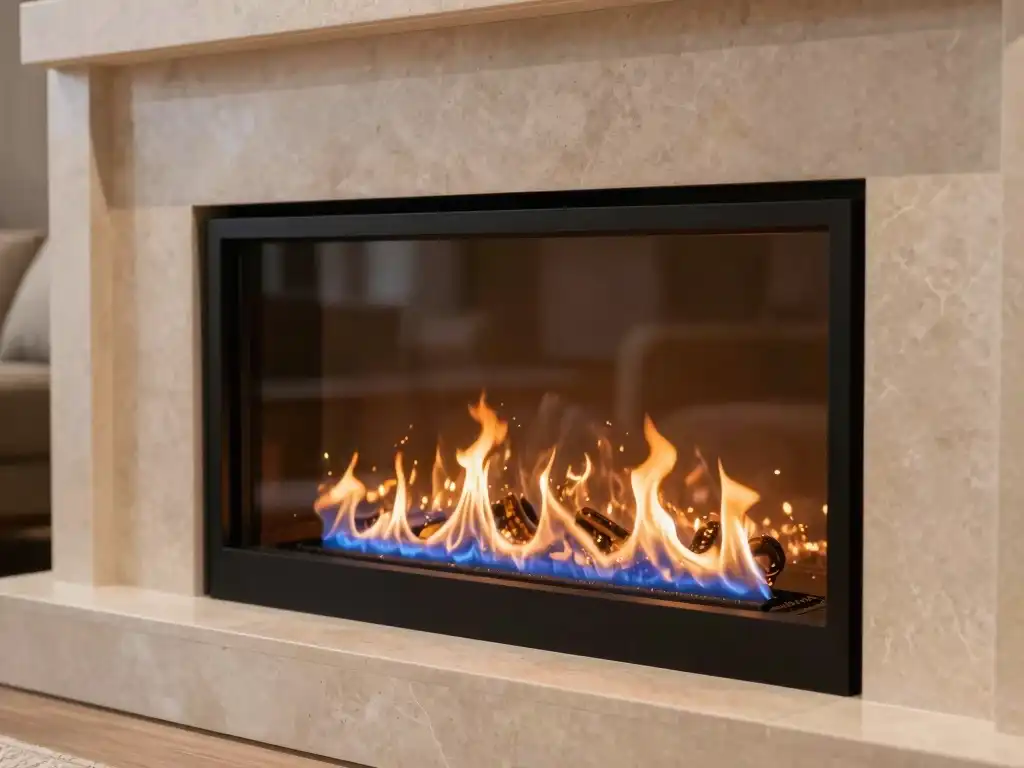
Turning Your Old Wood Fireplace Into a Gas Insert – The KC Way
Mechanics don’t lie, and neither does a heating bill. Most open wood fireplaces in Kansas City are actively costing you money on the coldest nights-pulling your conditioned air up the flue like a slow drain while you pile on another log and wonder why the room still feels like a barn. Dropping a direct-vent gas insert into that existing box flips the whole equation: you’re replacing a leaky, uncontrolled hole with a sealed appliance that actually puts heat where you’re sitting-and I’m going to walk you through exactly how that works, what it’ll cost, and what can blindside you inside a KC chimney.
Why Your Old Wood Fireplace Is Failing as a Heater in KC
On more than half the estimates I run in older KC homes, I end up saying the same thing: your wood fireplace is an exhaust fan, not a heater. That open firebox is connected directly to the outside air, and the moment you crack that damper, your house starts breathing conditioned air up the flue. On a five-below, wind-driven January night in Kansas City-the kind where the gusts are coming off the river-that fireplace can exhaust several hundred cubic feet of warm air per hour. Your furnace is picking up the slack, and you’re not even noticing because the fire looks nice.
Here’s the engine analogy that always lands: your open wood fireplace is like running a classic truck with the choke stuck wide open. Lots of fuel burning, plenty of noise, and you’re going nowhere fast. A gas insert is the fuel-injected modern engine in the same truck body-controlled combustion, no wasted draw, and the energy goes exactly where you want it instead of vanishing into the sky above your roofline.
- ✅ Room feels colder after a fire than before-especially once the fire dies down and the flue is still open.
- ✅ You feel a draft moving across the floor whenever the damper is open.
- ✅ Soot stains or smoke odor linger in the room, but it never actually feels warm.
- ✅ Your thermostat kicks on more often during or right after a fire-your furnace is compensating for what the fireplace is exhausting.
- ✅ You’ve caught yourself cracking the oven door open for heat on the coldest nights.
If you’re only thinking about how the new flames will look and not how the whole “engine” will run, you’re about to spend good money on bad performance.
What a Gas Insert Really Does Inside an Existing Fireplace
Think of your gas insert like dropping a modern fuel-injected engine into a classic truck: the brick body stays exactly where it is, but the working guts become a sealed, controlled system. A direct-vent gas insert is a self-contained firebox that pulls combustion air in from outside through one pipe and pushes exhaust out through another-both running up inside your existing chimney. Air in, fuel in, exhaust out. Nothing is borrowed from your living room air. Nothing is left to chance by wind pressure or house draft.
One January morning, it was five below with the wind screaming off the river, and I walked into a Brookside bungalow where the couple was heating the house with the oven door open. Their old wood fireplace looked charming-great brick, nice mantel-but it was basically a giant hole leaking warm air into the atmosphere. We converted it to a direct-vent gas insert that same afternoon. I’ll never forget the husband standing there in his socks, watching the flames kick on with a remote, saying, “We should’ve done this ten winters ago.” The room hit comfortable temperature in under an hour. That’s what a sealed appliance does that a campfire box never will.
Now, vent-free inserts exist, and you’ll find them cheaper at the big-box stores. A retired engineer in Lee’s Summit did his homework-binder full of printouts, convinced vent-free was the smart call-until I held a CO meter near his existing gas logs and showed him the readings. We installed a sealed direct-vent insert up his old masonry chimney instead, and he was genuinely impressed by the combustion numbers on my manometer. Honestly, in Kansas City, I treat vent-free inserts in existing wood fireplaces as a last resort. Running a vent-free appliance in a tight, well-insulated KC home is like running an engine in a closed garage-technically possible, not something I’d recommend for real-world comfort and safety.
| Old Wood-Burning Fireplace | Direct-Vent Gas Insert (Same Opening) |
|---|---|
| Open box-room air feeds the fire and escapes up the flue | Sealed box-combustion air pulled from outside through a dedicated intake pipe |
| Low heat output; most BTUs escape with the smoke | Engineered to capture and radiate heat into the room while exhausting only combustion byproducts |
| Starting a fire means hauling wood, kindling, and cleaning ash | Flip a switch or use the remote-no ash, no kindling, no waiting |
| Draft and smoke behavior depend on wind and house pressure | Draft is controlled by the appliance and vent design-consistent performance regardless of conditions |
| Damper left open accidentally = continuous heat loss all night | Insert sealed when off-no more “chimney as a straw” robbing your furnace |
Step-by-Step: The KC Way to Convert Wood to Gas Insert
Let me be blunt: if you want a gas insert for an existing fireplace in KC, the fireplace shell is usually the least of your problems. The firebox opening might be perfectly fine. It’s the flue, the liner, the gas routing, and the power that are the real engine-and if any one of those components is undersized, cracked, or cobbled together by a previous owner with a YouTube education, you’ve got a tuning problem before the new appliance ever fires up.
What Really Drives Cost on a Gas Insert for an Existing Fireplace in KC
When I sit down at your kitchen table and you ask, “So, what will this really cost?”-here’s how I break it down. Think of it like a parts list for an engine swap: you’ve got the unit itself, the venting and liner, the gas line work, the electrical rough-in, and any chimney repairs that surface once you look at the guts. Crown damage, failed mortar joints, offset flue tiles-those are line items that show up after the hood is open, not before. Each one has a price, and pretending otherwise doesn’t help anybody.
That 1920s Plaza condo job is the one I use to explain why “simple conversions” aren’t always simple. Owner ripped out his old gas logs himself before I arrived-already covering up evidence I needed. When I shined a light up that flue during a thunderstorm, I found cracked clay tiles and a flex gas line kinked so hard it looked like a pretzel. What started as a straightforward insert job turned into a full liner replacement, smoke chamber repair, and new gas run. Kansas City’s freeze-thaw cycles and decades of DIY patch jobs are common wildcard costs-but catching them during a proper inspection is a fraction of what it costs to ignore them and call someone in after a CO alarm goes off.
| Scenario | Existing Conditions | Work Included | Typical KC Range |
|---|---|---|---|
| Standard conversion | Sound masonry fireplace, decent crown, no major flue damage | Direct-vent insert + co-linear liner + new gas run/tie-in + basic surround | $4,500-$7,000 |
| Insert + moderate chimney rehab | Older brick with crown cracks, minor flue defects, some tuckpointing needed | All above + crown rebuild and localized flue repair/parging | $6,500-$9,500 |
| Insert in a “DIY history” fireplace | Prior gas logs or DIY work, unknown liner condition, flex line problems | All above + removal of unsafe hardware, full liner replacement, smoke-chamber repair | $7,500-$11,000+ |
| Insert in condo/HOA building | Shared chases, HOA vent rules, access challenges | Direct-vent insert + co-linear liner + coordination/approvals + possible roof work | $6,500-$10,000+ |
KC-Specific Gotchas: What Mo Checks Before You Order Anything
I still remember the first time I saw a 1960s ranch with a perfectly good firebox and a chimney that looked like Swiss cheese on the inside. That’s Kansas City housing stock in a nutshell. The 1920s Brookside and Plaza condos I work in regularly have beautiful brick exteriors hiding clay liner tiles that are decades past their service life. Lee’s Summit ranches from the ’60s and ’80s often have patchy crowns and amateur gas stub-outs from some previous owner’s weekend project. Mission Hills homes sometimes have legacy gas lines that were capped and forgotten when the original gas logs were pulled. Each of those neighborhoods has its own typical failure pattern, and knowing that before I ever touch your fireplace is how we build a realistic scope-not a pleasant surprise budget that doubles on demo day.
Here’s the thing I tell every customer who’s gotten a suspiciously low quote somewhere else: any bid for a gas insert for an existing fireplace in KC that doesn’t clearly spell out liner sizing, current chimney condition, and the full gas routing plan isn’t a bargain-it’s a blind estimate. That contractor is treating a serious mechanical system upgrade like a piece of furniture delivery. And honestly, that’s usually when ChimneyKS gets the call to come in after the fact and sort out what went wrong. Don’t be that second call.
- ⚠️ Ripping out old gas logs or grates before a pro inspection – you can hide or damage evidence needed to price and plan the job correctly.
- ⚠️ Vent-free insert plans in tight, well-insulated homes – poor air quality and CO buildup are real risks in KC winters, especially in newer construction.
- ⚠️ Reusing old, undersized, or kinked flex gas lines – like the knotted line in that Plaza condo, they restrict fuel flow and create leak points that don’t announce themselves quietly.
- ⚠️ Skipping a full chimney and liner inspection – a cracked or undersized flue can turn a well-intentioned “upgrade” into a carbon monoxide problem or a fire hazard.
- ✅ How often you actually use the current wood fireplace-once a year or twice a month changes the math.
- ✅ Any smoke, draft, or odor issues you’ve noticed-even years ago-that seemed weird but got ignored.
- ✅ Whether there’s already a gas line or gas starter anywhere near the fireplace, and who installed it.
- ✅ Age of the home and any known chimney repairs, remodels, or previous gas log installations.
- ✅ HOA or condo rules about exterior changes or roof penetrations-especially relevant in Plaza and Brookside multi-unit buildings.
Common Questions About Gas Inserts in Existing KC Fireplaces
By this point in the conversation-whether we’re at your kitchen table or I’m standing in your firebox with a flashlight-Kansas City homeowners tend to circle back to the same three or four questions. Heat output, power outages, and whether the original brick is going anywhere. Here’s how I answer them.
A gas insert for an existing fireplace in KC is only as good as the inspection, venting, and gas work behind it-same as any engine swap, the parts you can’t see are the ones that matter most. Call ChimneyKS and let Mo scope your chimney, sketch a clear upgrade plan on the spot, and give you a straight answer on whether a gas insert is the smart move for your Kansas City home.