

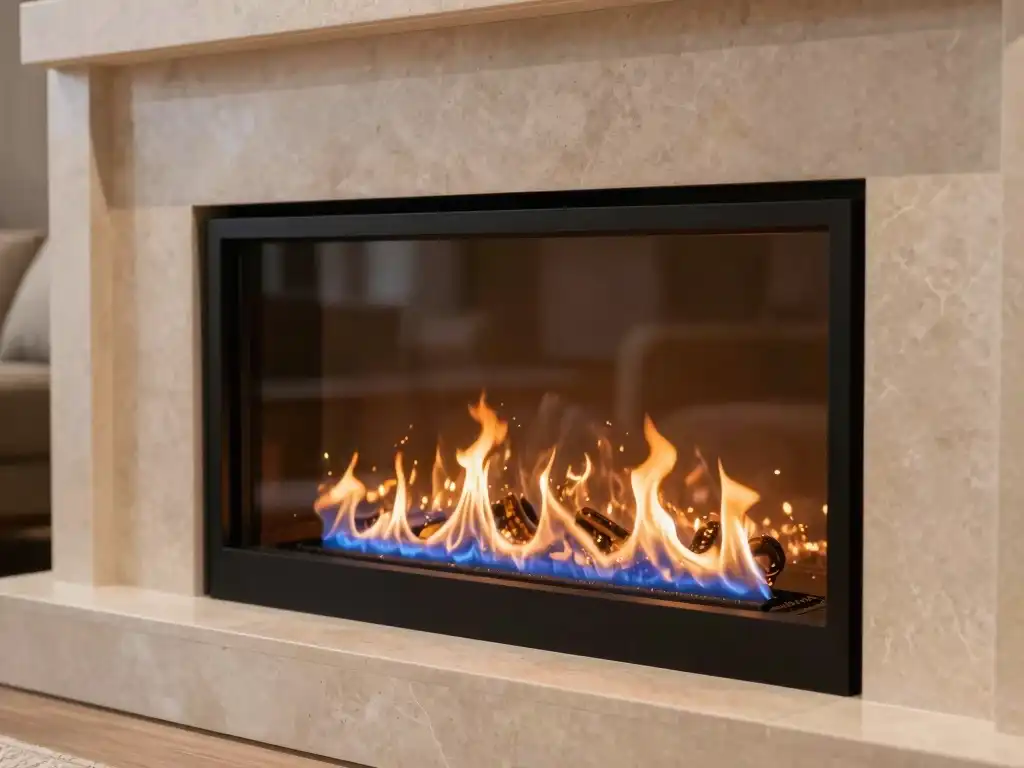
Gas Fireplace Won’t Turn On? Here’s What to Check in Your Kansas City Home
Blueprint for diagnosing a dead gas fireplace is exactly what I use on every Kansas City service call – most units that won’t turn on are sitting in one of three simple, fixable categories, and the whole job is just working down the list in order until one “flight” shows a delay. I’m going to walk you through the same first steps I’d run at your house so you know what’s safe to check yourself and when it’s time to bring in ChimneyKS to finish the job.
Start at the Gate: Power, Controls, and Gas Supply
First thing I ask when I walk in a house is: “Has anything changed recently?” – a tripped breaker, a new appliance plugged in nearby, a cleaning crew through last week. Not because I’m being nosy, but because most “dead” fireplaces aren’t actually dead. They’re grounded at the gate. Power and controls are always the first flight on the board, and you’d be amazed how often that’s the whole story before we even talk about gas or ignition.
One Friday night in late October, a restaurant in downtown Kansas City called in a panic because their lobby gas fireplace wouldn’t turn on and they had a line out the door. The manager thought the whole unit was shot and was ready to replace it. After squeezing behind the decorative stone in my dress clothes – I’d been at my kid’s band concert – I found that a cleaning crew had unplugged the fireplace to charge a floor scrubber and never plugged it back in. I plugged it back, reset the control board, and they looked at me like I’d hacked the Pentagon. I just told them: “Airplanes and fireplaces have one thing in common: if they’re not powered, they’re not going anywhere.”
Gas supply is the third part of this first check, and it’s sneakier than it sounds. The shutoff valve handle right near the fireplace is easy to miss – confirm it’s parallel to the pipe, not perpendicular. And here’s one I still think about: one January morning, just after an ice storm, I got a call from a couple in Olathe who swore their brand-new fireplace was “possessed” because it would click but never light. Both of them were wearing coats indoors, three space heaters running full blast. Turned out the installer had never removed the little shipping cap in the gas valve compartment, so the pilot was trying its best with no real fuel supply. I showed them the tiny plastic piece, said, “Your fireplace didn’t fail – it just never got checked into the flight,” and that’s still the fastest miracle repair I’ve ever had. Moral: don’t force a stiff or corroded valve, and don’t assume a new unit is automatically ready to go.
First Three “Flights” to Check When Your Gas Fireplace Won’t Turn On
Safe DIY Checks You Can Do Right Now – No Tools, No Panels
- ✅ Confirm power is available: Breaker on, outlet live, any wall switch feeding the outlet actually turned on.
- ✅ Cycle every obvious control: Wall switch, remote, and any rocker or dial on the unit itself – note what each one does or doesn’t do.
- ✅ Check thermostat settings (if tied in): Make sure the setpoint is above room temperature and the mode is set to heat, not just “fan” or “cool.”
- ✅ Look for indicator lights: Many control modules have a small status LED that signals power or flashes error codes – worth a look before anything else.
- ✅ Listen on a single start attempt: Do you hear a click, a fan spin, a faint hum, or absolutely nothing? Write down exactly what you hear – it tells a technician a lot.
Next on the Board: Pilot, Ignition, and Safety Sensors
If we were looking at this like an aircraft checklist, the next item is your pilot system. Think of it this way: power and controls are the gate check – if those clear, you’re boarding. The pilot and ignition system is the actual runway clearance. Clicking without flame usually means the igniter is trying but either the spark isn’t reaching the pilot or the gas isn’t getting there. A tiny flame that appears and dies almost immediately is usually a safety sensor issue – the thermocouple or flame sensor isn’t reading the heat and shuts gas flow back off as a precaution. Each of those is a separate “flight” on the board: one’s delayed, one’s denied boarding, and each one has a specific reason I’d work through in order before moving to the next.
One of the more stressful calls I’ve had was during that polar vortex a few years back – about 11 p.m., in a North KC split-level. The homeowner was convinced there was a gas leak because the fireplace wouldn’t turn on and they smelled “something weird.” I shut off the gas, ran my leak detector, and found nothing dangerous. Just a clogged burner and a decade’s worth of dust baking on the logs from a unit that had never been serviced. I cleaned the pilot, cleared the orifices, cycled the unit three times, and walked them through what normal combustion smell actually is versus a real raw-gas leak. Real leaks are sharp, persistent, and strong – they don’t wait. Dust-burn smell fades after a few minutes. That’s the distinction. And that night reminded me how many people sit in front of a completely fixable fireplace, just scared, not knowing which one they’re dealing with. If there’s any doubt, treat it as real and call – but don’t assume the worst before ruling out the obvious. That said: if basic checks above haven’t restored normal operation, this is where DIY stops. No open flames, no poking at sealed components.
What You Hear or See vs. What’s Probably Happening in the “Cockpit”
| What You Notice | Flight Status | What a Tech Like Dano Checks |
|---|---|---|
| No click, no hum, totally silent | Power/control flight canceled | Breakers, outlets, low-voltage wiring, control board power supply |
| Repeated clicking, no flame, no gas smell | Ignition flight delayed | Igniter position, spark strength, pilot orifice for clogs, wiring to igniter |
| Small flame appears, then dies immediately | Pilot/sensor flight denied boarding | Thermocouple/flame sensor condition and output, gas pressure to pilot, safety switch readings |
| Unit lights, then shuts off after a short run | Safety sensor flight diverted | High-limit switches, vent blockage or restriction, draft issues, overheating components |
| Remote works, wall switch doesn’t (or vice versa) | Control routing misdirected | Switch wiring, control board settings, battery-powered vs. line-voltage signal paths |
Kansas City Conditions That Quietly Ground Your Gas Fireplace
Back in my airline days, we had a saying: the airplane usually tells you what’s wrong if you listen the right way – your fireplace does the same. And Kansas City doesn’t make it easy on these units. Ice storms and polar vortex events can ice over a direct-vent termination cap completely, starving the unit of combustion air or blocking exhaust. That’s an immediate no-start or safety shutdown, and it happens fast – we’re talking a few hours of freezing rain and your fireplace goes from fine to grounded. Summer brings its own problems: remodels, new range hoods, window replacements, and extra attic insulation all change how your house breathes. A tighter house means pressure changes that affect how well your fireplace vents, and a unit that worked perfectly last winter might fight itself the first cold day after you had new windows put in. I see this exact sequence more than people expect.
And here’s an insider tip I’ve picked up from those calls: if cleaning crews, electricians, or HVAC contractors have been through recently, I always check for unplugged units, tripped breakers, or new exhaust fans that shifted the house pressure. The long-unserviced dusty burner from that North KC polar vortex call and the restaurant’s unplugged unit are both examples of how environment and usage frequency stack up quietly. A fireplace that sat all summer with no maintenance is a different animal by November – dust, spider webs in the orifices, and minor corrosion on terminals are all real and routine. None of that is dramatic, but all of it can ground a “flight” without giving you any obvious warning sign the day before.
Common Myths About Gas Fireplaces That Won’t Turn On
| The Myth | The Reality |
|---|---|
| “If it’s off all summer, it’ll be fine next winter.” | Idle months let dust, spider webs, and corrosion accumulate. First cold start of the season often exposes what built up while you weren’t watching. |
| “If I smell something, it must be a gas leak.” | Many no-start smells are dust burning off or flue odors. Real raw-gas leaks are sharp and persistent. When in doubt, shut off and call – but don’t assume the worst before checking the simple stuff. |
| “If the remote battery light is on, power must be fine.” | The remote only handles the signal. The fireplace still needs reliable line or transformer power, plus intact control wiring, completely independent of the remote’s battery. |
| “If it worked yesterday, nothing major can be wrong today.” | Small things – an iced vent cap, a tripped safety, a loose connector – can flip a system from fully operational to no-go overnight. Especially true in a Kansas City winter. |
| “Resetting it a dozen times will eventually clear the issue.” | Repeated failed starts can build unburned gas in the firebox and stress components. After 3-4 safe attempts, the right move is diagnosis – not another try. |
Simple Checklist You Can Follow Before Calling a KC Technician
Here’s the blunt truth about most gas fireplaces that won’t turn on in Kansas City homes: the underlying cause is usually simple in principle, but that doesn’t make all of them safe to fix yourself. Checking whether the breaker is on? Absolutely yours to do. Removing sealed glass panels, probing gas piping, or poking around the control module? That’s professional territory, and not because I’m trying to drum up work – it’s because gas systems have safety interlocks for a reason, and bypassing or misreading them creates problems that are a lot worse than a cold living room. Check what’s on the list below. If that doesn’t get it going, the checklist stops there.
Think of it like three main flights on the departure board: power and controls, gas supply, and pilot/ignition. You can visually confirm the first two without any tools or disassembly. The third one requires you to observe a single start attempt and report what you see and hear. If all three flights are showing delays after those basic checks, the board is telling you it needs a trained technician to run the rest of the diagnostics – and continuing to try on your own at that point is just guessing.
Dano’s At-Home Quick Checklist – No Tools, No Panels Removed
-
1
Confirm power is available. Check the breaker, test any outlet the unit uses with another device (a lamp works), and make sure no nearby GFCI has tripped. -
2
Cycle every obvious control. Wall switch on and off, remote with fresh batteries, and any rocker or dial on the unit’s lower louver – without removing sealed glass. -
3
Verify the gas shutoff valve. Find the handle near the fireplace and confirm it’s parallel to the pipe (open). Don’t force a stiff or corroded valve – that’s a tech call. -
4
Observe a single start attempt. Stand nearby and listen – do you hear clicks, see any indicator LEDs, or notice a momentary fan hum? Note the exact sequence before trying again. -
5
Stop after 3-4 failed tries. You’ve done the safe checks. Further attempts at this point belong to a technician with the right tools to diagnose, not just retry.
⚠️ When NOT to Keep Trying to Start Your Gas Fireplace
- ⚠️ You smell strong, persistent raw gas in the room – shut off the gas supply if you can safely reach it, ventilate immediately, and leave the area before calling.
- ⚠️ Your carbon monoxide detector chirps or alarms when you attempt to start the unit – stop immediately and call a pro before anyone re-enters the space.
- ⚠️ You see scorch marks, melted trim, or cracked panels around the fireplace – don’t operate it under any circumstances until it’s been inspected.
- ⚠️ You’ve already tried starting it more than 3-4 times in a row – repeated attempts can stress components and allow unburned gas to collect in the firebox.
If you’ve run through that checklist and your fireplace still won’t even try to start, it’s time to stop guessing and let a technician read the “flight board” for you.
How a Kansas City Technician Works Through the Rest of the “Flight Board”
On a Tuesday last February, I spent 40 minutes proving one tiny switch was the entire problem – a faulty high-limit switch that was tripping the safety circuit before the burner could ever fire. The homeowner had been calling it a “bad fireplace” for three years and running space heaters instead. Forty minutes, one component, done. That’s the diagnostics part that requires tools and training: once you’ve cleared the homeowner-safe checks, a tech like me moves into millivolt readings on the thermocouple, gas pressure tests at the valve, vent flow measurements, and deeper control module diagnostics. Each step crosses one more “flight” off the board – not by guessing, but by measuring. By the time I’m done with a full diagnostic on a no-start call, every possible cause has either been confirmed or ruled out with actual data, not hunches.
A gas fireplace that won’t turn on is almost always more “delayed” than “canceled” – as long as you respect the safety systems and troubleshoot in the right order, the odds are good it’s a fixable problem. Give ChimneyKS a call and let Dano run the full diagnostic checklist, identify the real fault, and get your Kansas City fireplace cleared for departure before the next cold night hits.