

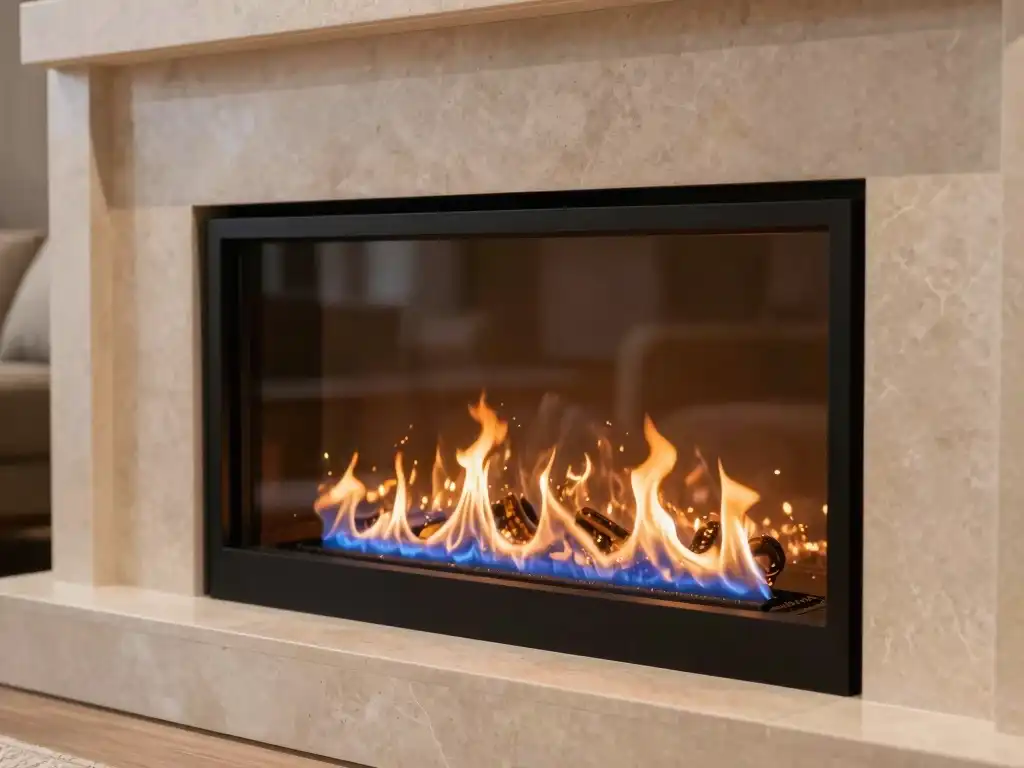
5 Good Reasons to Put Glass Doors on Your Kansas City Fireplace
Everybody says it’s fine – the fire’s going, the room looks warm, what’s the problem? Here’s the counterintuitive part nobody mentions: an open fireplace can make a room feel less comfortable even while a fire is burning, because the fireplace itself is pulling conditioned air out of the house and leaving the opening uncontrolled when the burn changes.
Why an Open Fire Can Make the Room Feel Worse
Everybody says it’s fine, and honestly, it looks fine – there’s a fire, there’s light, the room smells like wood smoke. But what’s actually happening is more like running a machine with a slipping belt and gaps in every seam. The fireplace creates a draft column up the flue, and that column doesn’t just pull combustion gases out – it pulls whatever air is nearby, including the warm room air you paid to heat. Leave the opening uncovered and the system leaks constantly, the way an old belt drive slips every few rotations and bleeds energy you never see going anywhere. The drag is real; it just doesn’t announce itself.
Seventeen winters in Kansas City taught me this: open fireplaces don’t just lose heat while the fire’s burning – they keep losing it after. Warm room air gets tugged up the chimney even as the fire dies down, and when the burn changes or the draft reverses slightly, cooler air settles back in around the opening before you’ve had a chance to close the damper. You can feel it as a vague chill near the hearth that doesn’t match the fire you’re looking at. Glass doors solve several separate problems at once – heat loss, smoke control, spark containment, draft behavior – and that’s why they’re worth talking through properly instead of treating them as decoration.
| Myth | What Actually Happens |
|---|---|
| An open fireplace always adds warmth to the room | The draft column pulls heated room air up the flue. Radiant heat from the fire rarely offsets the convective loss, especially in larger rooms or when the burn is low. |
| If smoke goes up, the draft is working fine | A functioning draft doesn’t mean an efficient one. Smoke going up the flue tells you nothing about how much warm air is going with it or what happens when wind direction shifts. |
| Glass doors are mostly decorative | Properly fitted glass doors reduce heat loss, slow down draft swings, contain sparks and embers, and help control smoke odor – none of that is decorative. |
| Closing the damper later fixes the heat loss | By the time the fire dies down and you close the damper, hours of warm room air have already moved up the chimney. Glass doors reduce that loss during and after the burn. |
| Only old fireplaces need doors | Any open-face fireplace – regardless of age – has the same basic airflow behavior. Older masonry systems often make it more obvious, but the physics applies to all of them. |
Five Practical Payoffs Homeowners Notice After Adding Doors
Less Heat Loss When the Fire Burns Down
Here’s the part homeowners usually don’t love hearing. The fireplace you think is warming the room is often stealing comfort from the rest of the house at the same time. I did a job in late October for a retired couple in Independence who were closing their damper faithfully after every fire and still waking up to a cold house. I put my smoke pencil near the firebox opening and let them watch their warm room air drift right up the flue even with the fire dead. They laughed when I said, “Your fireplace is eating your furnace’s lunch.” But that’s exactly what was happening. Glass doors – fitted properly – are the most direct way to keep reason #1 from costing you money every night the fire burns down.
Better Control Over Smoke, Smell, and Stray Sparks
On a windy Waldo evening, just before a Chiefs playoff game, I got a call from a homeowner whose living room kept filling with that campfire smell every time the north wind pushed. The flue was part of the story, sure, but the bigger issue was that an open firebox with no doors left the system completely exposed to pressure changes at the opening. Every draft shift pulled air and odor back into the room. That’s reason #2: less smoke smell in the house. And it ties directly to reason #3 – steadier draft behavior when Kansas City wind shifts, which happens a lot in the older houses in Brookside and Waldo where the masonry systems weren’t built for tight modern envelopes. Glass doors give the system a controlled face instead of a wide-open gap that reacts to every gust.
Ask yourself one plain question: when was the last time something popped out of your fireplace and you were grateful nothing was nearby? I did a liner inspection in Prairie Village on a sleeting January Tuesday, and by the end of the visit I was also measuring for glass doors because the homeowner’s golden retriever had singed the fur on its tail after a log shifted and a spark landed on the hearth rug. Nobody was trying to run a dangerous fireplace – the setup just had nothing between the fire and the rest of the room. That’s reason #4: spark containment. Reason #5 is quieter but real – a fireplace with properly fitted glass doors looks like a finished part of the room when it’s not in use, instead of a dark open box collecting dust.
Pretty flames do not automatically mean the fireplace is doing its job.
| # | What You Notice at Home | What the Doors Change Mechanically |
|---|---|---|
| 1. Less overnight heat loss | The house stays warmer after the fire fades. The furnace doesn’t work as hard by morning. | Doors reduce the open-air column effect that pulls room air up the flue even after combustion slows. |
| 2. Fewer smoky odors | That stale campfire smell doesn’t linger in furniture and curtains the way it used to. | Doors limit the airflow path through which smoke and gases can re-enter the room when draft pressure reverses. |
| 3. Steadier draft behavior | Wind gusts and pressure changes outside stop pushing smoke smell back into the room. | A controlled face on the firebox opening reduces how much the interior column reacts to exterior wind shifts. |
| 4. Spark and ember containment | Logs that shift and pop don’t land on the rug or nearby furniture. | Tempered glass panels create a physical barrier between the firebox and the room without blocking radiant heat. |
| 5. Cleaner look when not in use | The fireplace opening looks intentional and finished rather than a dark gap in the wall. | A fitted frame closes off the firebox face and reduces cold-air intrusion from the flue when the damper has minor leakage. |
Quick Summary: Five Reasons to Add Glass Doors
- ✔ Holds room heat better after the fire burns down
- ✔ Cuts down smoky odor drift into furniture and living spaces
- ✔ Helps tame wind-related draft swings common in Kansas City
- ✔ Blocks sparks and rolling embers from reaching the room
- ✔ Makes the fireplace opening look finished when not in use
Where Glass Doors Help Most in Kansas City Houses
Blunt truth – glass doors earn the most noticeable return on mid-century and older masonry fireplaces where the system looks acceptable but has too much open-air leakage to behave consistently. The firebox is solid, the chimney draws, but the whole thing operates like a machine with a worn gasket: it runs, it just doesn’t hold. In my experience, if a fireplace gets used more than a few times each winter, properly fitted glass doors are one of the simplest upgrades with the most immediate comfort payoff. Not a renovation. Not a liner replacement. Just a controlled face on an otherwise open system.
Open Fireplace
Room comfort during burn: Variable – warm near the hearth, drafty a few feet away
Smell after the fire: Smoky odor lingers and drifts back in with draft shifts
Ember control: Sparks can exit the firebox freely; screen helps but doesn’t seal
Overnight heat loss: Warm room air continues moving up the flue after the fire dies
Appearance when not in use: Dark open opening, collects ash dust and cold air
Fireplace With Glass Doors
Room comfort during burn: More consistent – controlled airflow reduces cold-air return around the opening
Smell after the fire: Draft-path restriction reduces smoke re-entry when wind pushes from outside
Ember control: Tempered glass panels block sparks and rolling embers from reaching the room
Overnight heat loss: Doors reduce open-face leakage so less warm air escapes after burn-down
Appearance when not in use: Clean, finished look that reads as part of the room
Kansas City Fit & Function Notes
Best Fit For
Older brick fireplaces and mid-century masonry systems – especially homes in Brookside, Waldo, and Independence-era neighborhoods
Biggest Complaint Solved
Smoky smell drifting into the room and inconsistent draft behavior when Kansas City wind shifts direction
Not a Fix For
Damaged flues, cracked liner sections, chronic backdrafting from structural chimney faults, or deteriorated fireboxes
Worth Checking First
Door sizing against the actual firebox opening and overall firebox condition – both affect whether doors will work as expected
What to Verify Before You Install Them
What Doors Can Improve and What They Cannot Repair
It works a lot like an old pinball cabinet: if one rail is bent, one relay is loose, or one catch is worn, the whole game plays differently than the designer intended – and adding a new backglass doesn’t fix any of that. Same deal with glass doors. They improve what an otherwise sound fireplace does, but they don’t substitute for a functional liner, intact firebox panels, a working damper, or reasonable draft geometry. If the flue is cracked, if there’s a backdraft problem rooted in the chimney’s design, or if the firebox is deteriorating – those need to be addressed first. Doors on a compromised system don’t save the system; they just add something to look at while the underlying problem continues.
Here’s the insider part that actually matters: fit. I’ve seen homeowners order a generic-size door set online because the measurements were close enough, and end up with gaps at the frame corners that undercut the whole point of having doors in the first place. A sloppy frame fit means air still moves freely around the edges, which means you’re getting the look without most of the function. Measuring the opening at the top and bottom – not just the middle – and checking that the lintel bar is straight and accessible before ordering matters more than which brand name is on the box. Don’t skip the field measurement.
Before You Order or Schedule: Six Things to Confirm
- Confirm the door type matches your fireplace fuel. Wood-burning and gas fireplaces have different clearance and venting requirements for glass doors – don’t assume they’re interchangeable.
- Measure the opening width at both the top and the bottom. Masonry openings often aren’t perfectly square; an inch of difference changes your fit significantly.
- Measure the opening height and firebox depth. Depth matters for frame clearance and whether certain door styles will sit flush at the opening face.
- Check that the lintel bar is straight and accessible. A bent or recessed lintel can make standard mounting hardware unusable without modification.
- Look for cracked refractory panels or damaged brick inside the firebox. Visible deterioration should be addressed before you install anything over the opening.
- Ask whether any smoke or draft problems have already been inspected. If the answer is no, get that inspection first – doors won’t fix what hasn’t been diagnosed.
⚠ Important Limitation
Glass doors do not fix a damaged liner, correct chronic backdrafting caused by structural chimney faults, or compensate for an unsafe firebox. If those problems are present, installing doors changes the appearance of the opening – not the safety or performance of the system. Get the chimney inspected before you put anything over the front of it.
Questions People Ask Before Making the Upgrade
Homeowners usually want to know whether doors will block the visual of an actual fire, whether they interfere with burning wood, or whether they’ll look like something out of a 1987 showroom. Fair questions – here’s what’s actually true.
If your Kansas City fireplace is giving off smoke smell, drafts, or more open-hearth mess than it should, ChimneyKS can inspect the setup and tell you plainly whether properly fitted glass doors make sense for your specific system. Call us and we’ll take a look before you spend money on something that may or may not solve the right problem.