

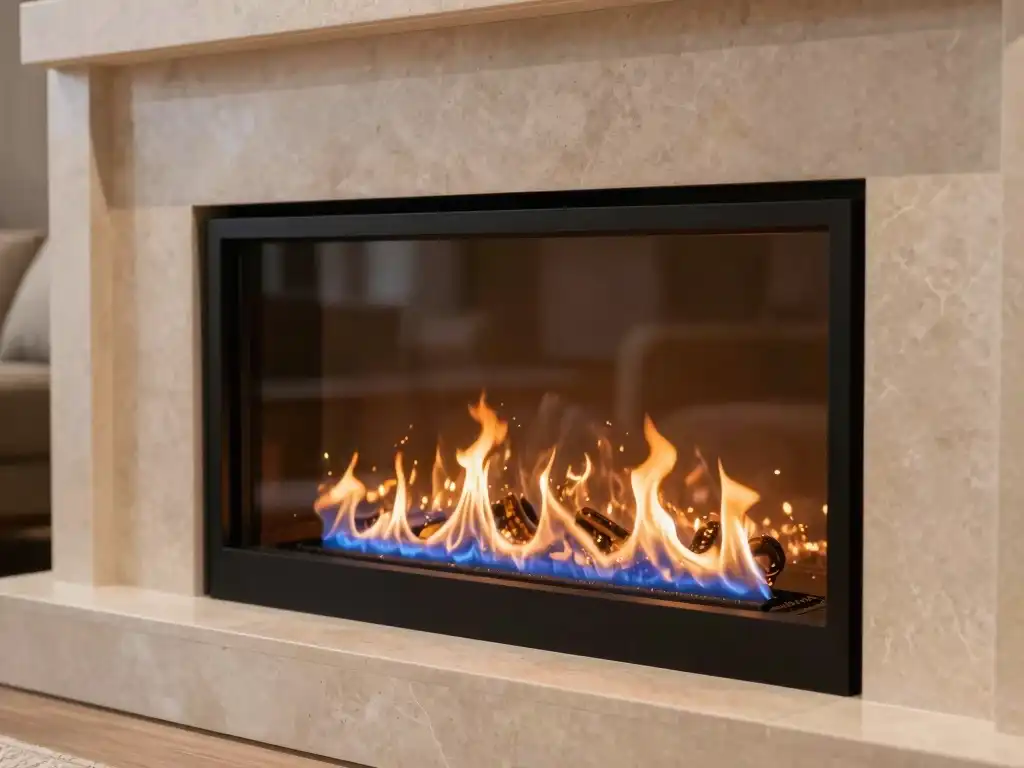
How Much Does an Outdoor Fireplace Cost in Kansas City?
Picture a fully installed outdoor fireplace in your Kansas City backyard – that project runs roughly $8,000 to $30,000+ depending on size, fuel type, and what your specific site demands. The spread is wide because some projects are straightforward prefab gas features on open patios, while others are full custom masonry builds dealing with structure, chimney performance, covered-patio clearances, and finish upgrades that add cost at every layer.
What Kansas City Homeowners Actually Pay
Picture the two ends of the range sitting side by side: a simple prefab gas unit dropped onto an open patio with a basic stone surround, and a large custom wood-burning fireplace with a full masonry chimney, raised hearth, and covered-patio heat shielding. One job wraps up around $8,000-$12,000. The other pushes well past $30,000. Both are real Kansas City projects, and the gap between them isn’t padding – it’s fuel system, foundation depth, chimney design, and finish choices adding up layer by layer.
In Kansas City, I usually tell people to think about outdoor fireplace cost in three buckets: what makes it burn, what makes it last, and what makes it look expensive. And honestly, I’d rather help someone build a slightly smaller fireplace correctly than watch them stretch the budget on size and then pay a second time to fix draft issues or clearance problems. Getting those three buckets right the first time is what separates a project you’re proud of ten years from now from one that becomes a repair call every spring.
Break the Project Into the Parts That Move the Number
What Makes It Burn
$8,000 sounds great until you ask what it actually includes. A low quote often stops at the firebox unit and basic surround, leaving out footing depth, gas line routing or wood supply clearance, chimney height, cap design, and finish detailing. Those line items aren’t optional extras – they’re the difference between a fireplace that performs correctly and one that smokes, cracks, or fails a code inspection. Get those details in writing before you compare numbers across contractors.
What Makes It Last
Now strip the stone off it for a second. What you’re left with is the foundation, the firebox walls, the flue system, and the drainage plan – and that’s where Kansas City really tests a build. Freeze-thaw cycles here aren’t gentle. We get storm exposure, hard winters, and suburban patio layouts in places like Lee’s Summit, Prairie Village, and Overland Park that put outdoor fireplaces in tricky spots relative to covered structures and runoff patterns. The footing needs proper depth and drainage. The firebox needs quality refractory materials. The flue needs correct sizing and a cap that handles Missouri wind. Absorbent veneer on an exposed exterior? That’s a one-season mistake. These hidden structural and weatherproofing costs don’t show up in the pretty photos, but they determine whether the thing is standing in ten years.
What Makes It Look Expensive
Before we even talk about the pretty part, understand that everything in this category is additive – it sits on top of a correctly built foundation, not in place of one. Stone selection, raised hearths, wood storage niches built into the surround, seat walls that frame the seating area, countertop surfaces for a prep ledge, low-voltage lighting worked into the structure, custom mantel treatments – these all affect appearance far more than they affect how well the fire burns. They matter. They’re worth doing if the budget supports it. Just don’t let finish upgrades get quoted in place of structural essentials.
| Build Layer | Typical Choices | How It Affects Price | What Homeowners Often Miss |
|---|---|---|---|
| Foundation & Footing | Depth varies by load and soil; drainage gravel or French drain | Deeper footings and added drainage add $800-$2,500 to the base | Shallow footings crack in KC freeze-thaw and trap water in veneer joints |
| Fuel System | Prefab gas insert vs. full wood-burning masonry firebox | Gas line extension or utility routing often adds $1,000-$3,000 alone | Quotes sometimes exclude the utility connection entirely |
| Chimney & Draft | Height, cap style, flue size, clearances near roofline | Covered patios require extra chimney height and shielding – adds $2,000-$6,000+ | Wrong chimney height is the #1 cause of smoke rollback problems |
| Veneer & Surround | Manufactured stone, natural stone, brick, stucco – all vary in absorption rating | Exterior-rated non-absorbent materials cost more upfront but avoid re-facing in 3-5 years | Interior-rated veneers used outdoors crack and delaminate fast in KC winters |
| Finish & Aesthetic Upgrades | Hearth height, niches, seat walls, countertops, lighting, mantel detail | Purely additive – can range from $1,500 to $10,000+ depending on scope | These upgrades get confused with structural items in vague quotes |
- ✅ Utility line extension for gas – the route from your meter to the patio is often longer and pricier than buyers expect
- ✅ Deeper footing or reinforcement – soil conditions and load requirements vary lot by lot across the KC metro
- ✅ Chimney height increase for draft – standard height doesn’t always clear rooflines, pergola beams, or nearby walls
- ✅ Non-absorbent exterior-rated veneer – using interior-grade stone on an exposed KC exterior is a repair waiting to happen
- ✅ Heat shielding and clearance work near covered structures – any roof, pergola, or overhead beam changes the build requirements significantly
Where Backyard Layout Can Save Money or Waste It
If I’m standing on your patio, the first thing I ask is how much depth you have between where the firebox face will sit and where people will actually be sitting. That single measurement touches everything – seating clearance, firebox sizing, foundation footprint, and whether the roofline above creates a draft problem or a heat trap. Think about it like a stage: the audience-facing side gets all the attention, and that’s where the stone choice and hearth height earn their keep. But backstage – the venting path, the structural clearances, the chimney height relative to what’s overhead – that’s where cost quietly gets determined. A fireplace changes the whole geometry of the yard, and if the layout is fighting the budget from the start, no amount of pretty stone fixes that.
One backyard in Prairie Village taught me that inches genuinely matter. The homeowner had a Pinterest board full of big dramatic fireplaces, and the patio was close but not quite right for the size they wanted. We moved the seating arrangement about fourteen inches toward the house, brought the firebox down one size, and suddenly the proportions worked, the clearances were clean, and the estimate dropped by several thousand dollars – without losing any of the visual impact they were after. The fire still looked great. The layout just stopped fighting itself, and the budget followed.
Smaller unit, open patio, gas preferred
Fireplaces built too close to seating walls create heat and smoke problems that no cap design fully corrects. Placing a fireplace under the wrong roofline traps draft and damages overhead framing. Ignoring prevailing wind direction means smoke rolls toward the house or directly into the seating area every time. Squeezing a fireplace onto a patio that forces awkward clearances creates code issues that are cheap to fix on paper – and expensive after the concrete, framing, or finish work is already done.
These errors are always easier and cheaper to catch at the estimate stage than after the build begins.
Mistakes That Turn a Bargain Fireplace Into an Expensive Lesson
Here’s the blunt part: the cheapest quote on your table might not include the corrections that only appear after smoke rolls back into your patio, moisture gets trapped in the structure, veneer starts separating, or an inspector flags a clearance issue. I saw exactly this on a Saturday morning in Brookside after an overnight rain – an outdoor fireplace another contractor had started and walked away from. The footing had pooled water underneath it, the veneer they’d chosen was far too absorbent for an exposed Kansas City exterior, and the customer kept asking why the price to “just finish it” was so much higher than the original quote. I had to walk them through it slowly: outdoor fireplace cost isn’t just materials listed on an estimate sheet. It’s also the cost of undoing bad decisions before freeze-thaw weather turns a problem into a full structural failure. By the time we corrected the footing drainage, swapped the veneer for an exterior-rated material, and got the chimney to the right height, they’d spent more than a properly built project would have cost from the start.
A fireplace is a little like a stage set – what the audience notices is the stone and the fire, but what keeps the whole scene standing is the hidden structure behind it.
Questions Worth Asking Before You Approve the Estimate
What are you really buying: fire, durability, or appearance? A solid estimate should spell out all three clearly – not lump them together under a single line item called “outdoor fireplace.” I had a family in Overland Park call me during Chiefs season because smoke was rolling back under their covered patio every time they had people over. Burgers on the grill, kids in the yard, and every few minutes smoke drifting into the seating area. I could see in about two minutes that the chimney height was wrong for the roofline and the cap design wasn’t suited to the prevailing wind pattern that covered patio created. They thought they’d gotten a deal on their outdoor fireplace. By the time we corrected the draft, addressed clearance issues, and repaired finish damage on the overhead structure, it was a very expensive lesson. Every bidder you talk to should be able to tell you specifically what chimney height they’re quoting, what cap design they’re using, how they’re handling drainage, and what material rating the veneer carries. If they can’t answer those questions clearly, that’s where the budget gap lives. A generic internet range won’t tell you what your specific yard needs – but a site visit will.
-
✅
Patio dimensions – rough length, width, and depth so we know what we’re working with before we arrive -
✅
Photos of the roofline or pergola – if anything is overhead or nearby, snap it from a few angles -
✅
Preferred fuel type – gas vs. wood-burning changes the estimate significantly, so decide early if you can -
✅
Finish inspiration photos – stone style, hearth height, any aesthetic details you have in mind -
✅
Note of nearby seating walls or structures – anything within 10-12 feet of the planned location affects clearance planning -
✅
Any prior contractor work or existing concrete – let us know upfront so we can assess what we’re working with or working around
If you want a real number for your yard instead of a generic internet range, ChimneyKS can walk the patio, look at the roofline, talk through fuel type and finish goals, and give you a site-specific estimate that actually reflects what your project will cost. Reach out and we’ll come take a look.