

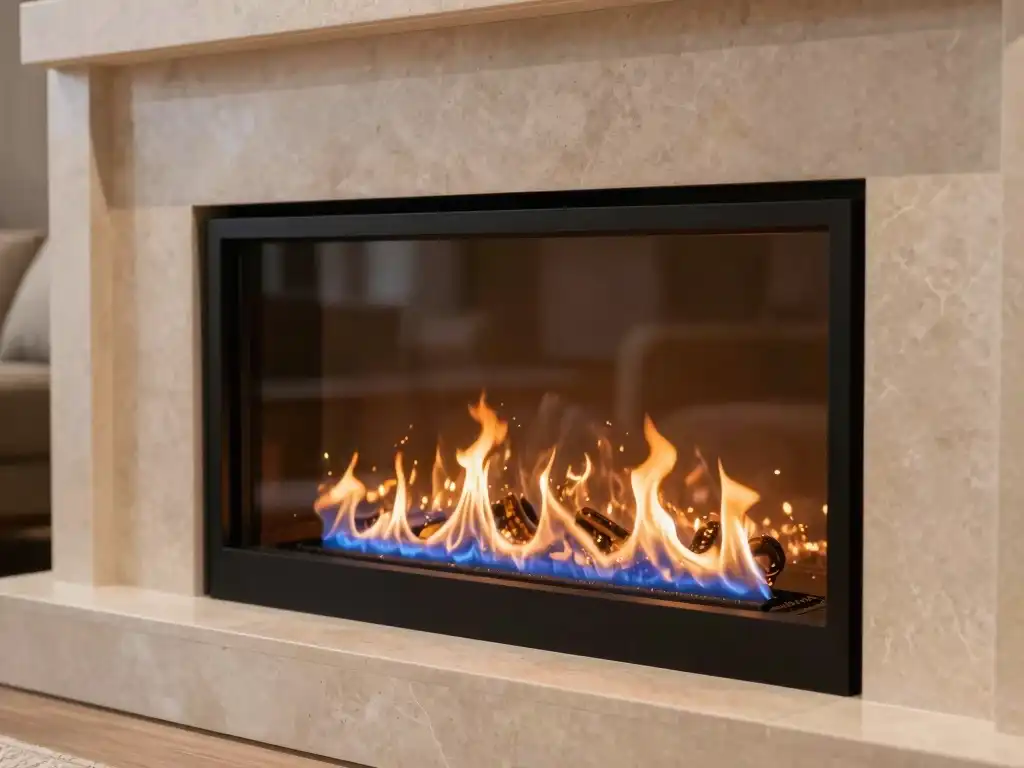
Outdoor Fireplace Installation – Transform Your Kansas City Backyard
Blueprints for the best outdoor fireplaces I’ve built in Kansas City all start the same way – not with a stone sample or a Pinterest photo, but with a specific chair on a cold night and one question: where do you actually want to be sitting when that fire is going? I’m going to walk you through how fuel choice, yard layout, wind patterns, and real budget numbers come together so that what you build out there becomes something you use every October through March, not a very expensive piece of yard art.
Start With Where You’ll Sit, Not With Stone or Price
Picture future-you. It’s 35 degrees, there’s a coffee mug in your hand, maybe a blanket across your lap. Your feet are going somewhere, your eyes are landing on something – that image is the whole design brief, and every decision about your outdoor fireplace flows backwards from it. I’ve seen people drop serious money on beautiful masonry structures and then never use them, and every single time the reason was the same: nobody asked that question before the first shovel went in. Seating position first, firebox location second, stone choices last.
One February evening, just after a sleet storm, I was standing in a half-frozen backyard in Overland Park with a couple who swore they had no space for an outdoor fireplace. I grabbed a folding chair, sat in the only dry corner of their patio, and realized the view lined up perfectly with their old oak tree and the downtown glow on the horizon. We pivoted the design 35 degrees, tucked the fireplace into a corner they’d completely written off as useless, and that project ended up on the local home tour the following year. Every time I drive by in winter, I can see the orange flicker through the fence slats. That’s what happens when you let future-you drive the design instead of the catalog.
| Seating Pattern | What It Feels Like | Ideal Fireplace Position | Typical Distance From Main Seating |
|---|---|---|---|
| Straight-On Viewing Like a TV wall |
Formal, focused – everyone faces the fire directly | Centered on the seating axis, fireplace built as a true backdrop wall | 8-12 ft from primary chairs to hearth face |
| Corner / Diagonal Viewing | Relaxed and casual – fire is in the sightline but not the only thing to look at | Angled into a yard corner; seating wraps around 45-90 degrees from the firebox face | 8-11 ft from the closest primary seat |
| Wrap-Around Conversation | Social and immersive – people sit on three sides; the fire is the center of the group | Freestanding or peninsula design in or near the center of the seating area | 8-12 ft from primary seating; equal spacing preferred on all sides |
Budget Ranges: What Outdoor Fireplaces Really Cost in KC
The blunt truth is, you can spend $15,000 on stone and still end up with a fireplace nobody uses if we ignore draft, wind, and seating. I’d honestly rather talk someone out of a build that won’t actually get used than take their money for a showpiece they regret come January. That said, here’s where real money goes: foundation work, masonry labor, a properly sized flue, gas line routing if you’re going that route, and tying the new structure into your existing hardscape so it doesn’t look bolted on. Most custom outdoor fireplaces in Kansas City land somewhere in the low-to-mid five figures, and there’s a reason for every dollar of that range.
Two fireplaces that look nearly identical in photos can be thousands apart in cost, and it’s almost never the stone that creates the gap. Grading, gas line distance, chimney height needed for clean draft, and how the structure ties into a patio or roofed area – those are the real variables. My habit is to sketch a simple system diagram for every homeowner I talk to, showing exactly where each piece of the budget is going, so nobody walks away staring at a lump sum wondering what they paid for.
Gas vs. Wood Outdoors: Comfort, Code, and Neighbors
Here’s my honest opinion: most outdoor fireplace installations in Kansas City fail not because of materials, but because someone treated the backyard like an afterthought – and fuel choice is one of the first places that shows. Wood gives you a bigger, more dramatic flame and genuine radiant heat, but you’re managing smoke every time and ember safety matters more outdoors than people expect. Gas fires are cleaner, easier to start on a cold night, and your neighbors will thank you – but they need more planning up front: gas line routing, venting specs, and HOA sign-off. And here’s an insider tip worth knowing: a lot of close-in Kansas City neighborhoods and HOAs lean strongly toward gas, and if you’re already having yard or patio work done, stubbing a gas line in at the same time costs a fraction of what it’ll run as a standalone project later.
I’ll never forget a July install in North Kansas City where the homeowner was determined to put the fireplace right up against a wood fence because he’d seen it on Instagram. It was 102 degrees, my crew was melting, and I had to stop the whole job mid-day to walk him through clearances and wind behavior while sweat dripped off my nose. We shifted the build four feet and added a masonry wing wall. Two months later, after the first windy evening, he called me and said, “Okay, I get it now – the smoke went exactly where you said it would have.” That job is why I’m a little stubborn about layout. It’s not personal. It’s just physics, and physics doesn’t care how good something looks in a photo.
Gas vs. Wood Outdoor Fireplace – Kansas City Comparison
⚠️ Clearance Mistakes That Turn Into Firefighter Visits
- Building too close to wood fences or siding. Clearance requirements exist because radiant heat and embers don’t stay politely inside the firebox. A few inches of compromise today can mean a structure fire in two years.
- Underestimating lateral wind push. In Kansas City, north and west winter winds can drive flame and smoke sideways across a patio and straight into soffits, porches, or neighbors’ windows. I’ve seen it happen in Prairie Village and Waldo on otherwise beautiful evenings.
- Tucking a fireplace under a low overhang without proper non-combustible construction and venting. Even small covered patios create heat and smoke trapping that a standard outdoor fireplace design doesn’t account for.
My stance on this has never changed: I’d rather bruise your ego during the design conversation than rebuild your house six months later.
Draft, Wind, and Sightlines: Making It a Fireplace You’ll Actually Use
When I walk into a yard for the first time, the very first thing I ask is, “Show me where you’d actually sit on a 35-degree evening.” From that chair – wherever it lands – I’m already watching the wind. Kansas City’s prevailing winter winds come in from the north and northwest, and they are not polite. On a flat yard with no natural break, a poorly positioned outdoor fireplace will roll smoke right across your seating area and sometimes clear across into a neighbor’s screen porch, which I have watched happen more than once on Prairie Village patios. So from that chair I’m also looking at the slope, what’s behind where the chimney will stand – the house, an existing tree line, a view toward downtown – and whether we can use any of that to our advantage. People around town know me as the guy who lines fireplaces up with sunsets, and that reputation started because I actually pay attention to what future-you is going to be staring at for the next hour.
There was a Saturday morning in late October when I arrived at a job in Lee’s Summit to fix an outdoor fireplace that another contractor had rushed through. The first time the homeowners lit it on a chilly Friday evening, smoke poured back so badly that a neighbor called the fire department. I spent that whole day dismantling the poorly built chimney stack, resizing the flue, and adjusting the firebox opening while the homeowners hovered in sweaters with their coffee. The problem wasn’t the stone. It was that the flue was undersized for the firebox opening, and nobody had thought about draft before anyone thought about finishes. That job changed how I run every consultation: airflow and draft come up before I ever ask what kind of stone you like.
If future-you is still dodging smoke and shivering in the wind, that beautiful stone fireplace failed its only real job.
From Sketch to First Fire: How Outdoor Fireplace Projects Work With ChimneyKS
Think of your outdoor fireplace like a stage in a tiny open-air theater – you’re not just building the backdrop, you’re deciding where the audience sits and where the spotlight hits. That’s genuinely how I approach the first conversation. I’ll show up with a scrap of paper, ask you to walk me around the yard, and somewhere in the first fifteen minutes there’ll be a doodle: fireplace on one side, seating arcs sketched in, a wind arrow in the corner, maybe a dotted line showing how a gas stub could run from the house. That’s when the project gets real. From there, we move from that napkin sketch to a proper permit-ready plan, locking in fuel type, materials, dimensions, and how the whole thing ties into your existing patio or any roofed structure you’re adding.
The build sequence matters and I walk every homeowner through it the same way. We start underground – footing or pier system sized for the real load – then move into the masonry or framed non-combustible structure, firebox installation, and flue or vent system. If gas is part of the plan, a licensed plumber handles that line before anything gets closed in. Stone finishes go last because stone should never drive structural decisions. And the final step is the one I like most: I stand in your yard with you, in your coats, and we run the first test fire on a cool evening. Not a warm-weather trial run. A real night, with real cold, to make sure future-you is actually comfortable out there.
The ChimneyKS Outdoor Fireplace Installation Process – Kansas City
Backyard Walk and Sit-Down
I walk the yard with you, find the spots where you naturally drift, and ask what you want to see beyond the flames. This is the whole design foundation.
Concept Sketch
I draw a simple top-down diagram right there – fireplace position, seating arcs, wind direction arrow, and any clearance flags. You leave with a doodle that makes the whole thing concrete.
Detailed Design & Quote
We refine fuel type, materials, dimensions, and any patio or roof tie-ins. You get a line-item estimate – not a lump sum – so you know exactly where each dollar is going.
Permits and Scheduling
We handle required permits and inspections for gas, structure, or zoning and schedule the build around weather windows. Kansas City spring and fall are our busiest seasons for a reason.
Construction
Excavation and footings first, then framing or masonry, flue and vent installation, stone or brick finishes, and licensed gas hookup if applicable. Typically 4-8 working days on site, 3-8 weeks from design approval to final fire depending on complexity.
Final Tuning and First Fire
We test draft and flame on a cool evening, adjust screens or wind guards as needed, and walk you through how to use it, what clearances to maintain, and what annual care looks like for your specific setup.
Questions Kansas City Homeowners Ask Before Their First Outdoor Fireplace
An outdoor fireplace is a small open-air theater – the flames, the backdrop, and where you sit all have to work together or the whole thing falls flat. Give ChimneyKS a call, and I’ll come stand in your yard, sketch a custom outdoor fireplace installation for your Kansas City home right on a napkin, and give you clear next steps and honest pricing so those sketches turn into real winter fires you’ll actually use.