

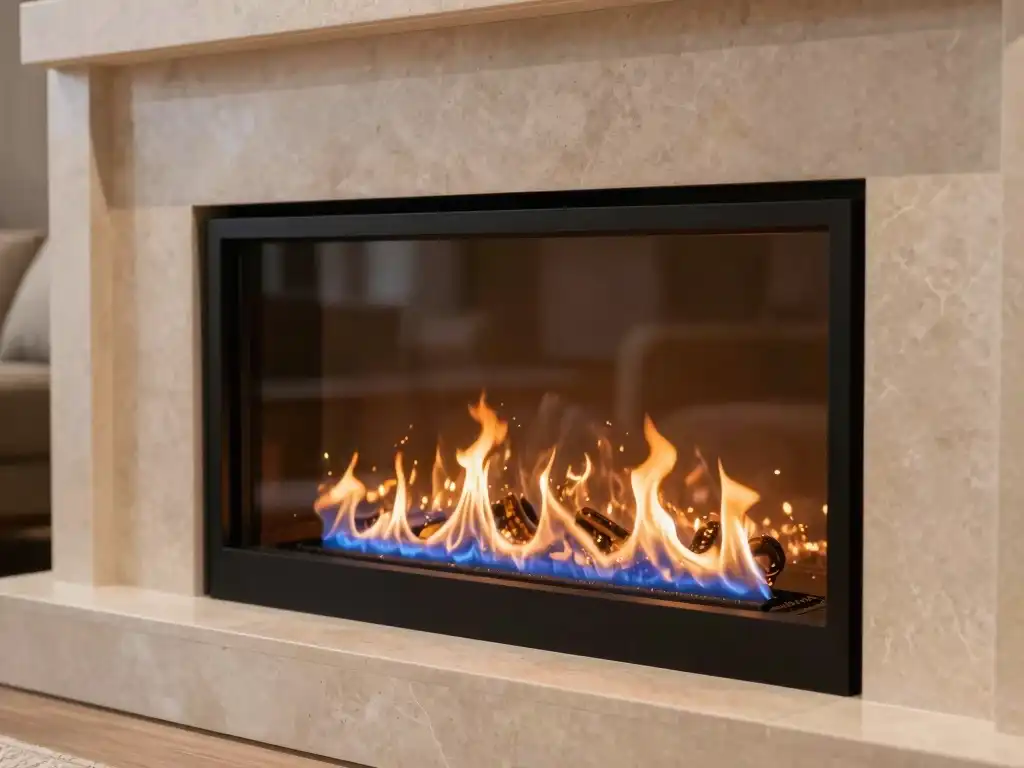
How to Clean Soot From a Gas Log Set in Your Kansas City Fireplace
Back up before you grab a rag-turn off the gas, step away from that fireplace, and let everything cool completely before you touch a single log. This guide will walk you through exactly how to clean soot from a gas log set the right way, and just as importantly, how to recognize when that soot is telling you something’s wrong that no amount of DIY cleaning is going to fix-which is when you call ChimneyKS.
Step One: Shut Everything Down and Let the Fireplace Cool
On my notepad, the first thing I’d draw for you is the gas shutoff valve-with a big red X over the flame symbol next to it. Before anything else, turn the fireplace off at the wall switch or remote, close any wall thermostat controlling it, and then walk to the manual gas shutoff valve on the supply line and close that too. Then you wait. Not five minutes-thirty minutes minimum, ideally a full hour. Glass panels, ceramic logs, and the metal firebox surround all hold heat longer than you’d think, and soot work on a warm surface just moves the mess around instead of removing it.
One January evening, it was about 10 degrees and sleeting sideways in Overland Park, and I walked into a living room where the homeowner swore her gas log set was “perfectly fine”-except every picture frame above the fireplace had a gray halo. She’d been repainting the wall trim every winter for three years. I cleaned the soot off the logs, then proved with a tissue test that her vent was backdrafting every time the kitchen exhaust fan kicked on. You know what fixed it? A one-dollar box fan used strategically to equalize room pressure, plus a proper cleaning. It looked like a cosmetic problem. It was an airflow problem. Those two things look almost identical until you actually go looking.
Pre-Clean Safety Checklist
- ✅ Turn the fireplace OFF at the switch, remote, and any wall thermostat.
- ✅ Locate and turn OFF the manual gas shutoff valve feeding the fireplace.
- ✅ Wait until the glass, logs, and metal parts are cool to the touch – at least 30-60 minutes.
- ✅ Ventilate the room – crack a window if you’ve noticed soot or any lingering odors.
- ✅ Check your CO detector in the same room has fresh batteries and is functioning before you start.
Tools and Supplies You’ll Need for Soot Cleaning
Think of your gas log set like a gas stovetop: you wouldn’t let the burners cake over in grease and expect a clean flame, right? And you definitely wouldn’t spray Windex on a burner grate and call it maintained. Same logic applies here. In Kansas City homes-and I see this constantly in both the older drafty bungalows in Waldo and the tighter newer builds out in Lee’s Summit-our humidity, seasonal dust, and let’s be honest, pet hair, all migrate into the firebox during the months you’re not using it. That means even a fireplace you only ran ten times last winter can look like a mess by the time October rolls around. What you clean it with matters as much as how you clean it.
| Item | Purpose | Notes |
|---|---|---|
| Soft-bristle paintbrush (1-2 inch) | Dusting soot from ceramic logs and burner | Dry only; no water on logs unless your manufacturer’s manual specifically allows it. |
| Vacuum with brush attachment | Collecting loose soot and debris from firebox floor | Use gently; avoid direct contact with burner ports or pilot assembly. |
| Microfiber cloths | Wiping metal surfaces and glass frame | Use dry or slightly damp with an approved cleaner only. |
| Gas fireplace glass cleaner | Cleaning inside of tempered or ceramic glass panels | Never use standard window glass cleaner or abrasives. |
| Disposable gloves & dust mask | Personal protection from soot and fine particulates | Especially worth doing if you have allergies or asthma-fine soot is no joke. |
| Owner’s manual | Correct log layout and cleaning guidelines | Look up your model number online if you don’t have a paper copy-most manufacturers post them. |
How to Clean Soot Off the Logs, Burner, and Firebox Safely
Here’s the part nobody advertises when they sell you those pretty gas logs: they still need regular, careful cleaning, and the soot on them isn’t just ugly-it’s a sign that something in the burn cycle is running a little dirty. Think of it like a greasy grill grate. You wouldn’t crank the heat on a grill covered in carbonized buildup and expect clean food, and you don’t want to keep lighting a gas log set with caked soot either. The goal here is gentle removal, not scrubbing like you’re going after a cast-iron pot.
I’ll never forget a Saturday morning in Brookside when I showed up to what was supposed to be a “quick soot wipe-down” on a vented gas log set. The owners had been using scented candles near the firebox and cleaning the glass with regular glass cleaner. By the time I got there, the burner ports were gummed up and the flames were curling black around every ceramic log. It took me two hours, a soft-bristle brush, and a full burner disassembly to get it burning clean again. Those scented candles left a film on everything. The glass cleaner baked residue right onto the panels. We had a long talk that morning about why “shiny” doesn’t mean “safe” when it comes to gas logs-and why what you use matters as much as how often you clean.
Here’s how I think about it: the logs in a gas fireplace are like calibrated burners on a commercial stove. Their position isn’t decorative-it controls where the flame impinges, how combustion air moves through the set, and whether you get a clean blue-gold burn or a sooty orange mess. You brush the soot off gently in place, vacuum the debris below, and you put every single log back exactly where the manufacturer’s diagram says it belongs. Not where it looks nice. Not where it fit last time you moved it. According to the diagram.
Step-by-Step: Cleaning Soot From a Gas Log Set
-
1
Confirm gas is off and the unit is cool. Double-check the shutoff valve position and press a control to verify nothing lights. -
2
Remove the glass front if your unit has one. Follow the manufacturer’s instructions exactly; set the glass on a soft surface away from kids and pets. -
3
Photograph the current log layout. Take clear shots from a few angles so you can put every piece back exactly where it was designed to sit. -
4
Dry-brush the logs. Using a soft-bristle brush, gently sweep soot from each ceramic log, working top to bottom so debris falls to the firebox floor. -
5
Vacuum the firebox floor. Using a brush attachment, lightly vacuum loose soot and debris-stay clear of burner ports and the pilot assembly. -
6
Inspect and lightly dust the burner. Use the brush to remove loose dust from around the burner ports only-do not poke anything into the tiny holes. -
7
Clean the glass with approved cleaner. Apply gas-fireplace-rated glass cleaner to a microfiber cloth and wipe inside and outside surfaces; avoid ammonia-based cleaners. -
8
Reinstall logs per the diagram. Use your photos and the owner’s manual to confirm each log’s exact position so flames don’t impinge directly on logs or glass. -
9
Reassemble the glass and frame. Make sure all clips and seals are properly seated with no gaps or misaligned sections. -
10
Test-burn and observe. Turn gas back on, light the unit, and watch for 10-15 minutes. Flames should be mostly blue at the base with gentle yellow tips-no fresh black soot forming.
If soot comes back fast after a careful cleaning, your fireplace isn’t just dirty-it’s trying to tell you the burn or the airflow is wrong.
When Soot Means a Bigger Problem Than Just Cleaning
Let me be blunt: if your gas log set is making black soot, something about that fire isn’t right. One humid July afternoon in Kansas City, I was called out to a house where the gas log set was leaving a perfect dusty outline of the family dog on the beige carpet every time the fireplace ran. The homeowner had done a little “redecorating” with the logs-moved them around to look better-and in doing so, choked off the burner’s airflow completely. The logs were stacked wrong, combustion was incomplete, and no amount of vacuuming the carpet was going to fix it. I reset the logs to the manufacturer’s diagram, cleaned the soot off the burner and ceramics, and we stood there and watched the flames go from an angry, sooty orange to a calm blue-gold. Dog prints on the carpet were gone inside a week.
And honestly, that story repeats itself constantly around Kansas City. In the older drafty homes near Brookside or Waldo, negative pressure from a powerful range hood or bath fan can pull exhaust back into the room. In the tighter newer builds-say, out toward Leawood or Lenexa-“house sealed up tight” in winter creates the same problem from the opposite direction. I’ll say it plainly: if you’ve done a careful cleaning, put the logs back correctly, and you’re still seeing fresh black soot after a fire or two, that’s a red flag. Low gas pressure, a partially blocked vent, wrong log placement, or pressure imbalances in the house are all things that need diagnosis-not a second round of wiping.
⚠️ Stop DIY Cleaning and Book an Inspection If You Notice:
- Fresh black soot returns within a fire or two after a careful, correct cleaning.
- Flames are mostly dark orange, very tall, or touching the logs or glass directly.
- The glass fogs heavily, hisses, or gets unusually hot in one specific spot.
- You smell a sharp, eye-stinging odor-or your CO detector chirps or alarms.
- The logs, burner, or gas line were ever moved or modified without a manual or a permit.
Those symptoms point to a combustion or venting issue-not just dirty logs.
Keeping Soot From Coming Back in Your KC Gas Fireplace
Here’s the thing about soot prevention: it’s mostly about burn habits and airflow management, not about which cleaner you buy. The Brookside job I mentioned earlier is a perfect example. Those homeowners were trying to keep things clean-they just used the wrong products and introduced new contamination every time they lit a candle nearby. It’s the same way a commercial kitchen hood gets ruined faster by someone spraying the wrong degreaser than by the normal cooking grease. The wrong cleaner creates a sticky film, the film catches more particles, and before long you’ve got a worse problem than you started with.
My practical advice, and I give this to pretty much every gas log customer I have: get the fireplace professionally serviced every one to two years. That’s it. That’s the single best thing you can do. A tech will check gas pressure, verify the vent path, inspect the pilot and burner, and confirm log placement-all the stuff that a wipe-down can’t touch. Between services, don’t put decorative rocks, pinecones, or candles inside the firebox unless they’re specifically listed for use with your unit. Run your kitchen hood and bath fans with some awareness-if you notice the flames dip or flutter when you flip on the range hood, that’s worth mentioning to a pro. And every single time you light the fireplace, glance at the flame shape and color for about 30 seconds. Blue at the base, gentle yellow tips, no black curling. Think of it like the pilot light check on a commercial range-you’d notice if a burner on your stove started throwing black smoke. Notice it here too.
| Task | How Often | What to Do |
|---|---|---|
| Quick visual check | Every time you use it | Verify flame shape and color, listen for odd noises, glance at glass for new soot or haze. |
| Light dusting | 1-2 times per heating season | With gas off and unit cool, gently brush and vacuum loose dust and soot from logs and firebox floor. |
| Professional service | Every 1-2 years | Full inspection of burner, pilot, gas pressure, venting, and log placement; deeper cleaning as needed. |
| CO detector check | Twice a year | Test nearby CO alarm, replace batteries annually, and replace the unit per manufacturer life span-often 5-7 years. |
Frequently Asked Questions
Can I use regular glass cleaner on my fireplace glass?
Not a good idea. Most household glass cleaners leave residues that bake onto the glass during a burn and can actually make soot stick worse over time. Use a cleaner specifically labeled for gas fireplace glass-it’s formulated to handle the temperature swings.
Is it okay to wash my ceramic logs in the sink?
No. Most manufacturers warn against wetting ceramic logs or using detergents on them-moisture can weaken the material and change how the logs radiate heat. Dry brushing is the move unless your specific manual says otherwise.
Why do I get more soot on very cold or very windy days?
Kansas City winters are rough on draft. Cold snaps and strong winds change the pressure balance in your home, and if the exhaust from your gas logs can’t leave cleanly, the fire tips toward sooty, incomplete combustion. That’s worth having a vent and combustion check done-not just a log cleaning.
How do candles affect my gas fireplace?
Scented candles, aerosols, and sprays can leave invisible films on logs and glass that change how the flame burns and where soot accumulates. Keep those well away from the firebox itself-and if you’ve been burning candles nearby for a while, mention it to your service tech so they know what they might be dealing with.
A clean gas log set burns more efficiently, looks a lot better, and stops depositing soot on your walls and trim-but only if the system behind it is burning and drafting the way it’s supposed to. If you’re dealing with stubborn soot that keeps coming back, flames that don’t look right, or you just want a pro to handle the annual dirty work properly, give ChimneyKS a call and we’ll sort it out.