

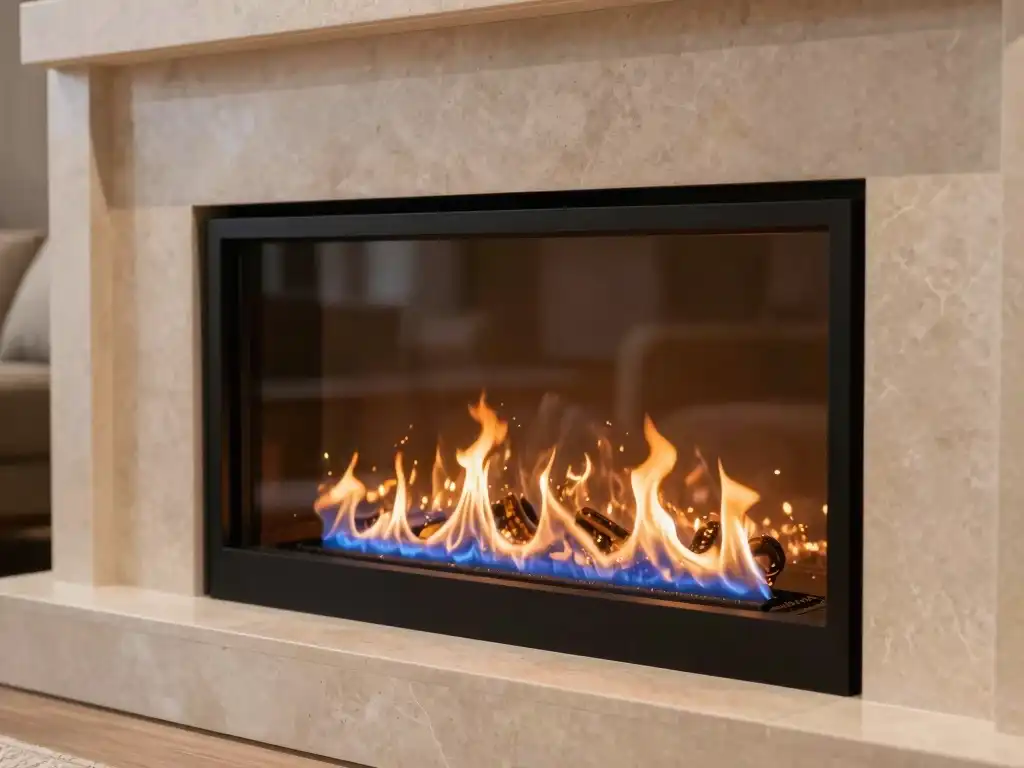
4 Common Gas Fireplace Myths That Cost Kansas City Homeowners Money
Mythbusters get a TV show. I get a little notebook. Some of the most expensive problems and biggest disappointments I see with gas fireplaces in Kansas City start with four product myths that sound completely reasonable in a showroom-and fall apart the first cold week of December. I’ve watched homeowners turn their furnaces off expecting a decorative unit to carry 2,000 square feet, buy “99% efficient” log sets that tripped CO alarms, and skip five years of service on units that were quietly burning 20% more gas than they should have. This article is that notebook, opened up for you.
Myth #1: “This Gas Fireplace Will Heat My Whole Kansas City House”
Let me be direct: if a salesperson told you your gas fireplace will “heat your whole house,” they were selling a dream, not a heating plan. Some of the most expensive disappointments I’ve seen-and I mean actual “why is my gas bill this high and why is my bedroom still cold” disappointments-start with that exact promise. I wrote “Myth #12: Any gas fireplace can replace your furnace” in my notebook on a freezing January evening in Overland Park, around 7 p.m., Chiefs game on in the background, sitting in front of a couple’s gas fireplace because it “wasn’t heating the house like it should.” They’d been told at the showroom it could heat 2,000 square feet. So they turned the furnace way down and expected the decorative unit to do the heavy lifting. It didn’t. They were cold, the bedroom was cold, and the gas bill was still high because the furnace kept kicking back on anyway.
Sitting there cross-legged on their floor with a flashlight, I pointed at the nameplate BTU rating and the vent configuration and explained it plainly: in their open floor plan, this unit was a really nice space heater for the living room. That’s it. Not a central system. Not a furnace replacement. And honestly, that’s not an insult to the unit-it’s just what it is. My personal take, after 15 years of these calls? I’d rather disappoint someone with the truth about what their gas fireplace can actually do than let them freeze all winter chasing a brochure promise. Think of gas fireplaces as zone heaters priced per square foot of comfort. The living room? Fantastic. The whole house? That’s what your furnace is for.
| Brochure Claim | Living-Room Reality in KC |
|---|---|
| “Heats up to 2,000 square feet!” | Ratings are often based on sealed test rooms, not drafty open floor plans. In practice, most units comfortably heat 300-600 sq ft around them. |
| “High-efficiency, whole-home comfort” | Gas fireplaces are excellent zone heaters and ambiance creators, but ducted furnaces and heat pumps still do the even, whole-house work. |
Typical BTU Outputs vs. Realistic Heated Area for KC Gas Fireplaces
| Input BTU Range | Realistic Heated Zone (KC Home) | Good Use Case |
|---|---|---|
| 10,000-20,000 BTU | Small sitting area or bedroom, 150-300 sq ft | Supplement bedroom heat or keep a small den cozy without cranking the furnace |
| 20,000-30,000 BTU | Average living room or open den, 300-500 sq ft | Primary comfort in main seating area on cold evenings |
| 30,000-40,000 BTU | Large living/dining combo, 400-700 sq ft | Anchor heat source for a big family room while the furnace handles the rest of the house |
| 40,000+ BTU | Very open great room or main level-still not whole-house in most cases | High-ceiling rooms or homes with lots of glass, used as a strong zone heater |
Myth #2: “High-Efficiency” Numbers on the Box Equal Lower Bills for You
Brochure world vs. Kansas City living room
On my service tablet, I’ve got a whole photo folder labeled “Marketing vs. Reality” for gas fireplaces, and it’s fuller than I’d like to admit. Efficiency stickers-AFUE ratings, steady-state numbers, lab-tested percentages-don’t always mean what homeowners think they mean. A lot of those ratings describe how completely the unit burns gas, not how evenly or usefully that heat spreads through your specific house. A unit rated at 78% AFUE in a controlled test might deliver genuinely excellent heat to a well-sealed living room-or it might heat the wall behind it while your family shivers six feet away, depending on how it’s vented and positioned.
Where “99% efficient” vent-free claims fall apart
First thing I ask when someone says “We bought this because it’s 99% efficient” is, “Efficient at what, exactly-making heat, or burning gas in a lab?” That question usually lands like a cold splash of water, but it’s the right one. The one that really got under my skin happened in a Liberty split-level around 11 a.m. on a sunny November day. The homeowner had bought a vent-free gas log set online because the ad said “No chimney needed, 99% efficient!” He’d installed it himself into a masonry fireplace that wasn’t designed for vent-free, in a tight living room with new windows. The carbon monoxide alarm had started chirping-which is why his wife called. Sitting at their kitchen table, I had to explain how that “99% efficient” number was measured in a lab, not in a real Kansas City home with their ventilation setup. We pulled the set out and replaced it with a properly vented option. That’s when “Myth #21: Vent-free means problem-free” went in my notebook.
Here’s where brochure world and living-room world really split apart. In the lab, that vent-free unit burns almost every molecule of gas-impressive number, clean burn. In a real KC home with kids opening doors, new tight windows, and variable air changes, you’re adding moisture and combustion byproducts to a sealed space. And KC’s housing stock makes this trickier than most places-older leaky bungalows and newer tight builds behave completely differently, and homeowners who upgrade windows without revisiting their venting setup can turn a fine vent-free installation into a code and safety issue overnight. The right way to think about efficiency isn’t “which box shouts the biggest percentage.” It’s: vented or vent-free, how often will you run it, and is it correctly sized and vented for your actual room? Start asking, “Is that a brochure number or a real-life number?” any time you hear a big efficiency claim.
Vented vs. Vent-Free Gas Options in Real KC Homes
| Factor | Vented (Direct-Vent or B-Vent) | Vent-Free |
|---|---|---|
| Combustion Air | Draws from outside; byproducts exit through a flue. Room air stays cleaner. | Burns room air; byproducts stay inside. Fine in large, well-ventilated spaces-risky in tight rooms. |
| Comfort Level | Consistent, dry heat; no added moisture or odor. | Adds moisture and can produce subtle odors; some people are sensitive to this, especially in newer tight homes. |
| Safety Margin | Higher. Combustion gases exhausted outside; CO risk is much lower when installed correctly. | Lower in tight spaces. CO alarm trips are not uncommon when room size, ventilation, or installation is off. |
| Practical Efficiency in KC | Slightly less heat retained per therm (some escapes through flue), but delivers that heat safely and comfortably. | Higher lab efficiency number, but only useful if installation conditions are right-which they often aren’t in older KC stock. |
⚠ Why “99% Efficient” Can Still Be the Wrong Choice
Vent-free systems earn their “99% efficient” rating in controlled lab settings-not in your Kansas City living room with new windows, a closed floor plan, and a family inside. In tight homes, these units can trip CO alarms, add unwanted moisture to the air, and produce odors that make the space uncomfortable to actually sit in. Codes, room size, and ventilation quality matter far more than a single percentage printed on a box. If your home has been tightened up with new windows or insulation since your vent-free unit was installed, it’s worth having that setup re-evaluated before you run it this winter.
Myth #3: “Gas Fireplaces Are Maintenance-Free-Just Flip the Switch”
What actually builds up inside a “clean” gas unit
Blunt truth: “maintenance-free” is a marketing phrase, not a mechanical reality for any appliance that burns fuel inside your house. I hear it constantly, and every time I pull the glass off one of these “maintenance-free” units, I find something that quietly costs the homeowner money. Gas fireplaces collect dust and lint on burner ports. They accumulate pet hair that restricts flame patterns. They develop soot on logs when the burner alignment drifts. Vent caps and terminations-especially in KC’s mix of humid summers and windy winters-collect debris, start rusting, and occasionally host wildlife. None of that is dramatic. All of it matters.
The Brookside sale that proved “maintenance-free” is expensive
On a mild March afternoon in Brookside, around 3 p.m., I was inspecting a chimney for a home sale. The seller told me proudly, “We switched to gas logs-these things are maintenance-free.” I asked when they’d last had the unit serviced. “Never needed it,” he said. When I pulled the glass, the burner ports were half-clogged with lint and dust, the logs were sooty from improper flame, and there was a bird’s nest starting at the cap. We cleaned everything and documented exactly why “maintenance-free” gas had quietly cost him in efficiency and safety. He’d run it through several KC winters without once checking what was inside. Here’s the insider tip: if your gas fireplace has never had its glass pulled and burner cleaned, but has run through multiple winters, it’s almost guaranteed to be burning more gas than it should. Treat it like any other fuel-burning appliance-checked and cleaned on a real schedule, even when it looks clean through the glass.
What Brian Routinely Finds Inside “Maintenance-Free” Gas Fireplaces
- ▸ Lint and pet hair packed around burner ports, restricting gas flow
- ▸ Spider webs in orifices-tiny, invisible from outside, real impact on flame
- ▸ Soot buildup on logs from misaligned or drifted burners
- ▸ Hazy or clouded glass that reduces radiant heat output into the room
- ▸ Loose or brittle door gaskets letting heat escape where it shouldn’t
- ▸ Bird nests or debris at termination caps-especially after KC spring and summer
- ▸ Shifted logs that cause improper flame patterns and incomplete combustion
- ▸ Corroded components from off-season humidity-common in KC’s wet shoulder seasons
Realistic Service Rhythm for Gas Fireplaces in Kansas City
Before each heating season, have the burner, ports, glass, gaskets, and termination cap inspected and cleaned. Catch alignment issues before they become soot problems.
Low use doesn’t mean low buildup. Dust, spider webs, and off-season moisture don’t care how often you flip the switch. A check every couple of years keeps the unit safe and efficient.
New windows, insulation, drywall work-any of these change how air moves through your space. Have the unit and its venting re-evaluated before the next cold stretch.
KC storms can damage vent caps, shift terminations, or deposit debris in flue runs. Don’t assume it’s fine because the flame lit. Get eyes on the whole system.
Myth #4: “Any Gas Fireplace Is Cheap to Run if It’s Labeled Efficient”
How run time, settings, and layout change the gas bill
Think of gas fireplace brochures like car commercials-yes, it can get 35 mpg, but not when you’re hauling kids, groceries, and driving through a Kansas City winter. Operating cost has almost nothing to do with the sticker on the box and almost everything to do with how many hours you run it, what flame height you choose, and whether you’re heating one room at full blast while your furnace works just as hard to heat the other four. The unit’s efficiency number is real. Your usage pattern is what turns that number into an actual gas bill.
I’ve run into this pattern more times than I can count in my notebook. A KC homeowner leaves their gas fireplace on all evening at max flame for “cozy”-which, fair enough, that’s what fireplaces are for-but they haven’t touched the thermostat, so the furnace is still firing every 20 minutes to hit the setpoint throughout the rest of the house. They’re paying for both. Twice. The fix usually takes about 10 minutes: drop the thermostat 2-3 degrees, let the fireplace carry the living room load, and turn the flame down to mid-range once the room is warm. Bill drops, room stays comfortable, and the fireplace is actually doing the job it’s good at instead of running alongside the furnace it was supposedly replacing.
At roughly $0.60-$0.90 per hour for a typical mid-size gas fireplace at full flame in Kansas City, “efficient” gets expensive fast if you treat it like 24/7 décor.
That’s the number I walk homeowners through on service visits-not the efficiency percentage, but the actual dollar-per-hour at their current gas rate, multiplied by real usage hours. Flame height matters more than most people realize: dropping from full to mid-range flame on a 30,000 BTU unit can cut hourly gas use by 30-40% while still keeping the room comfortable. Those are real-life numbers, not brochure numbers.
Simple Tweaks That Actually Make Gas Fireplaces Cheaper to Run
- Lower the flame once the room reaches a comfortable temperature-don’t let it run at max all evening.
- Use the blower or fan if your unit has one-it moves heat off the firebox and into the room instead of letting it radiate toward the ceiling.
- Drop the furnace thermostat 2-3 degrees when the fireplace is running so you’re not paying for both systems at once.
- Close doors to unused adjacent rooms where appropriate-the fireplace heats a zone, not a floor plan.
- Schedule annual tuning so the burner runs at peak efficiency and you’re not burning extra gas to compensate for clogged ports or misaligned logs.
- Use programmable remotes or timers-running the fireplace “because it looks nice” at midnight costs real money. Set a shutoff time and let it do its job, then stop.
Turning Myths Into a Smarter Gas Fireplace Game Plan
When I flip open my myth notebook on a homeowner’s living room floor, most pages come back to the same thing: brochure world vs. living-room world. The showroom promise versus what happens on a 20-degree Kansas City Tuesday with your actual floor plan, your insulation, and your usage habits. My goal isn’t to talk anyone out of gas fireplaces-they’re genuinely great tools for zone comfort and for making a living room feel like a living room. What I want is for Kansas City homeowners to match their expectations and settings to what their specific unit and home can actually deliver, so they stop wasting money on gas bills they didn’t have to pay, avoid safety issues they didn’t see coming, and get real, consistent comfort instead of disappointment backed by a brochure.
Four Big KC Gas Fireplace Myths – The Short Version
| Myth | Reality in Kansas City Homes |
|---|---|
| Any gas fireplace can replace your furnace. | They’re great zone heaters but rarely full furnace replacements-plan them as supplemental heat, not primary systems. |
| High-efficiency sticker = lower bills in any house. | Lab efficiency doesn’t guarantee comfort or safety in real rooms; venting and layout matter just as much as the percentage on the box. |
| Gas fireplaces are maintenance-free. | All fuel-burning appliances collect dust, soot, and wear. Regular checks keep them safe and efficient-skip them, pay for it. |
| If it’s labeled efficient, it’s always cheap to run. | Cost depends on BTUs, run time, flame setting, and how it’s coordinated with your main heating system-not what the label says. |
Gas Fireplace Myth Questions KC Homeowners Ask Brian
Why Kansas City Homeowners Trust Brian for Gas Fireplace Reality Checks
- ✓ 15 years hands-on with gas fireplaces and chimney liners in the Kansas City metro-enough jobs to fill several notebooks of myths
- ✓ Former appliance salesperson-which means he knows exactly how the marketing works and where it stretches the truth
- ✓ Reputation for blunt, fair myth-busting-he’d rather give you a real answer in 10 minutes than nod along and bill you for a callback
- ✓ On-site explanations using your unit’s actual labels and measurements-not general advice, not brochure numbers
- ✓ Fully licensed and insured through ChimneyKS, serving Kansas City homeowners who want straight answers, not sales pitches
Gas fireplaces are fantastic when you know what they really are-zone heaters and mood-makers, not magic furnaces or zero-maintenance décor that runs itself forever on a promise printed in a showroom brochure. If you want Brian to sit on your living room floor, flashlight and notebook in hand, and translate your unit’s labels and brochure claims into a simple, honest game plan for comfort, cost, and safety, give ChimneyKS a call-because that’s exactly what he’ll do.